
Robots and AI: Effects on Growth, Inequality & Central Banking
How do robots and artificial intelligence affect economic growth, wages, inequality, interest rates, and central banking? In this presentation, I discuss the economic consequences of automation and AI and what they could mean for workers, policymakers, and central banks. The presentation begins with the rapid spread of industrial robots and advances in AI capabilities before examining the main economic mechanisms through which automation affects the economy. A simple macroeconomic model shows how automation can raise productivity and generate long-run economic growth, while at the same time changing wages, interest rates, and the distribution of income between labor and capital. I then analyze the effects of automation on the labor income share and wage inequality. Industrial robots can reduce the labor share and, when they substitute particularly strongly for lower-skilled workers, increase the skill premium and wage inequality. A key question is whether AI is economically different from earlier forms of automation. Because AI can substitute for cognitive tasks performed by highly skilled workers, its distributional effects may differ substantially from those of industrial robots. The presentation discusses how AI can compress the skill premium while also putting downward pressure on the labor income share. The final part considers AI risks, including fraud, disinformation, cybersecurity threats, automated warfare, bioweapons, and misalignment. I also discuss an economic framework for evaluating the trade-off between the potential growth benefits of transformative AI and catastrophic risk. The presentation concludes with policy implications for education and retraining, social security systems, taxation, and AI safety and alignment research. #ArtificialIntelligence #Economics #Automation
Suggested videos
Returns to Scale | Microeconomics
Klaus Prettner · 7:25
AI and Inequality, a talk by Prof. Anton Korinek
Minh Trinh's Artificial Intelligence · 44:47
Schumpeterian Growth Model (One-Sector Version)
Klaus Prettner · 26:37
AI Is Dangerous, but Not for the Reasons You Think | Sasha Luccioni | TED
TED · 10:19
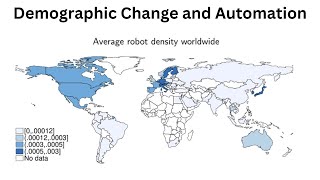
Automation and Population Growth
Klaus Prettner · 22:08
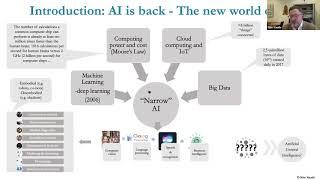
Cross-Border Coffee Break: The Economic and Business Impacts of Artificial Intelligence
Global Business School Network · 1:00:48
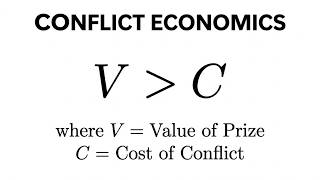
How to Peacefully Demobilize Rebels?
Klaus Prettner · 4:54
How Will People Generate Wealth If AI Does Everything?
Theo Von Clips · 5:10

Supply Curve | Microeconomics
Klaus Prettner · 6:13
Emergence of AI and Labour Market - Have the Edge
Startup & Business Entrepreneurial School · 3:23
Economic Growth With Capital Embodied Technical Change | Presentation by Sujata Pokhrel
Klaus Prettner · 47:43

Godfather of AI WARNS: "You Have No Idea What's Coming"
The Diary Of A CEO Clips · 20:57