
The Forever War and the First Amendment - Day 1
This September we will mark 25 years since 9/11. Many of us will be reflecting on the losses and the meaning of that day, and on how the legacies of that day still shape lives in New York, across the country, and around the world a quarter century later. On September 9th and 10th, the Knight Institute and Columbia’s Simon and June Li Center for Global Journalism will convene journalists, scholars, lawyers, and activists to explore one of those legacies in particular: The ongoing impact of the War on Terror on democratic rights, including the freedoms of speech and the press. First Amendment freedoms came under stress from the moment President George W. Bush declared a “War on Terror” and his press secretary warned Americans to “watch what they say.” Pervasive secrecy and censorship hid war crimes, torture, and other grave human rights abuses. Surveillance programs proliferated, from the NYPD’s targeting of New York Muslim communities to digital surveillance operations of unprecedented scope and reach. Anti-terrorism legislation criminalized forms of peaceful speech and association. The press struggled to fulfill its role, and when journalists did report on controversial and covert programs, they did so in the shadow of the Espionage Act, which the government deployed against journalists’ sources and threatened to deploy against journalists themselves. But those same First Amendment freedoms nurtured new forms of resistance, solidarity, and even accountability as well. Civil society groups and community organizations mobilized to defend civil liberties and protect targeted minorities. A new generation of journalists responded to the failures of legacy media by building new media tools and institutions in response to the failures, limitations, and blind spots of legacy media. What does all of this mean for us today? To what extent are we still living the Forever War, and in what ways are we now living in its shadow? How have the suppressions and distortions of the Forever War worked their way into our systems and psyches? Is our system of free expression stronger or weaker now? This symposium will explore these and other questions and assess the lasting significance of the Forever War for First Amendment freedoms and for our democratic institutions and culture. The symposium is co-sponsored by the Knight Institute and the Simon and June Li Center for Global Journalism at Columbia Journalism School in partnership with Harper’s Magazine and The Columbia Daily Spectator. Schedule 4:00PM – 4:15PM EDT Introductory Remarks Jameel Jaffer, Knight Institute Azmat Khan, Li Center for Global Journalism at Columbia Journalism School 4:15PM – 5:30PM EDT The Forever War’s Long Shadow How did the U.S. government’s response to 9/11 become embedded in our lives, our institutions, and our national mythology and character? In what ways can the defining features of our current political moment—the rise of authoritarianism, the erosion of democratic freedoms, the weakening of civic institutions, the coarsening of political discourse, the inauguration of new wars based on flimsy and constantly shifting pretexts, and the normalization of official impunity—be traced to decisions made, frameworks established, or habits adopted in the months and years following the attacks? Panelists Rozina Ali, The New York Times Magazine Assia Boundaoui, Inverse Surveillance Project Brett Max Kaufman, American Civil Liberties Union Aziz Rana, Boston College Law School Moderator Lydia Polgreen, The New York Times 5:30PM – 5:45PM EDT Break 5:45PM – 6:45PM EDT Reporting the Forever War How did reporting shape or distort the way that we understood the meaning and consequences of U.S. wars and counterterrorism policies? How did a shifting legal landscape—one that diminished access to battlefield and detention sites, expanded surveillance authorities, and enabled the increasingly aggressive exploitation of the Espionage Act by successive administrations—affect journalists’ ability to report on war and its implications? In what ways did the War on Terror give rise to the dangerous environment in which reporters do their work today? Panelists David McCraw, The New York Times Mohammed R. Mhawish, Craig Newmark Graduate School of Journalism at CUNY Dana Priest, The Washington Post Moderator Jelani Cobb, Columbia Journalism School
Suggested videos
The Forever War and the First Amendment
Knight First Amendment Institute · 5:02
The Forever War and the First Amendment - Day 2
Knight First Amendment Institute · 7:29:53
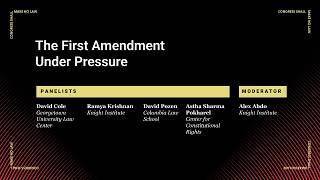
The First Amendment Under Pressure
Knight First Amendment Institute · 1:23:22
2028 Democratic hopefuls gather in Denver to plot party’s future
CNN · 3:21:44
Free Speech in America: Trump, Surveillance, & AI
Goldfarb Center for Public Affairs at Colby · 1:04:40
Democratic Lawmakers and Presidential Hopefuls at 2028 Strategy Conference
C-SPAN · 1:50:56
Welcome to the Knight Institute
Knight First Amendment Institute · 3:35
Why You Might Never Want to Take a Cruise Again | 5 TRUE CRIME Cases
Best Documentary · 3:25:57
Can Middleware Save Social Media?
Knight First Amendment Institute · 3:10:16
Watch the 101st annual Knoxville Veterans Day parade
WBIR Channel 10 · 1:16:40
The Bully’s Pulpit: Trump v. The First Amendment will be back next week
Knight First Amendment Institute · 1:52
SCHOLAR EXCHANGE: 14th Amendment, Part II from Roe to Obergefell - Round 2
National Constitution Center · 1:01:56