
Cover crop nitrogen credits for farms in California’s central coast, Ag Order 4.0
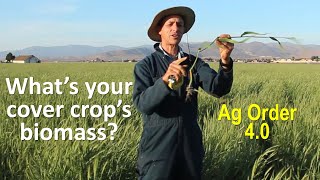
Non-legume cover crops scavenge left-over nitrogen & reduce nitrate leaching to ground water. Farmers in California's central coast region can get nitrogen scavenging credits for growing non-legume cover crops in the Ag Order 4.0 regulation. Dr. Eric Brennan describes the two types of cover cropping credits available and how farmers can use stem length to know when their rye and triticale cover crops have reached the 4500 lb per acre of oven-dry shoot biomass required to get a credit. He also explains how to use the Feekes scale for cereal growth stages to estimate the cover crop's carbon to nitrogen ratio (C:N) to get the higher credit. This is based on research for Merced rye (Secale cereale) and Pacheco triticale (X Triticosecale) cover crops grown the Salinas Valley (Monterey), Santa Cruz and Santa Barbara counties. The Ag Order 4.0 regulation applies to over 500,000 acres of irrigated land in the central coast region of California that is a major production area for high-value vegetables, strawberries, & many other tillage intensive, high-value, high-input crops. This video was presented at the October 13, 2022 meeting of the Central Coast Region Water Quality Control Board, in San Luis Obispo, California. Below are links to 2 Google sheet calculators the Eric made to allow growers to quickly predict the oven dry shoot biomass, C:N ratio, nitrogen uptake, and nitrogen scavenging credit for Merced rye and Pacheco Triticale cover crops. - Merced Rye Cover Crop Nitrogen Scavenging Credit Calculator https://docs.google.com/spreadsheets/d/1PoTp4WMFITLnScX7rj_qB7o290AP14D8PLdeiuMksZM/edit#gid=0 -Pacheco Triticale Cover Crop Nitrogen Scavenging Credit Calculator https://docs.google.com/spreadsheets/d/1KEqfiruOLD2_8pAO681QuzwTAYMGJaxgojqpE4g2AYM/edit#gid=0 -PDF link to the peer-reviewed paper with the research described in this video. Brennan E.B., R.F. Smith. 2023. Predicting cereal cover crop biomass using shoot length in California vegetable systems. Agricultural & Environmental Letters 8:e20099. https://acsess.onlinelibrary.wiley.com/doi/abs/10.1002/ael2.20099 The following video has more details on how to measure main stem length A simple way to estimate cereal cover crop biomass from stem length https://youtu.be/QwcFW30ILMQ
Suggested videos

Why I Love being a Civil Servant Scientist at the USDA-ARS in the Salad Bowl of America
Dr Eric Brennan USDA-ARS · 2:00

Historic Win for Farmers, Cover Crops, Soil & Ground Water Protection in California’s Central Coast
Dr Eric Brennan USDA-ARS · 3:03:56
Bumper Crops: Trapping nitrogen with cover crops
Univ of Wisconsin Integrated Pest and Crop Management · 2:40

Who Should Make Videos for the Scientist?
Dr Eric Brennan USDA-ARS · 16:15

Cover Cropping Strategies for Climate-Smart Farmers & Climate-Resilient Farms
Dr Eric Brennan USDA-ARS · 12:45
Can cover crop mixes of legumes & non-legume reduce nitrate leaching & protect water quality?
Dr Eric Brennan USDA-ARS · 27:31
Nonlegume winter cover crops make vegetable production more sustainable & protect water quality
Dr Eric Brennan USDA-ARS · 11:10

Juicing Cover Crops... Are you Nuts? Maybe, but hear me out.
Dr Eric Brennan USDA-ARS · 11:16

VP1 Vegetated Practice Benefits and Ag Order 4.0: Paula Ritcher
California Marine Sanctuary Foundation Ag Projects · 12:51

Cover Cropping is like ... Juggling
Dr Eric Brennan USDA-ARS · 1:58
The Indiana Farmer- Cover Crop Plot/Carbon Credit Plot
The Indiana Farmer · 2:27
A simple way to estimate cereal cover crop biomass from stem length
Dr Eric Brennan USDA-ARS · 8:02