
Interactive Simulacra of Human Opinions and Behavior
A conversation with Michael Bernstein, Associate Professor of Computer Science at Stanford University. This session is part of the Spring Seminar Series, a series spanning April through June, hosted at the Cyber Policy Center with the Program on Democracy and the Internet. Sessions are in-person and virtual, with in-person attendance offered to Stanford affiliates only. Lunch is provided for in-person attendance. Registration is required. Session will take place in McClatchy Hall #S40. McClatchy Hall is near the Oval, a short distance from Encina Hall. Believable proxies of human attitudes and behavior can empower interactive applications ranging from immersive environments to improved content moderation tools. Bernstein will illustrate this concept through two applications. The first is generative agents: computational software agents that simulate believable human behavior. Generative agents wake up, cook breakfast, and head to work; artists paint, while authors write; they form opinions, notice each other, and initiate conversations; they remember and reflect on days past as they plan the next day. We instantiate generative agents to populate an interactive sandbox environment inspired by The Sims, where end users can interact with a small town of twenty five agents using natural language. The second is jury learning: an AI architecture intended for tasks that feature substantial disagreement between people, which resolves these disagreements explicitly through the metaphor of a jury: defining which people or groups, in what proportion, determine the classifier's prediction. About the Speaker Michael Bernstein is an Associate Professor of Computer Science at Stanford University, where he is a Bass University Fellow and STMicroelectronics Faculty Scholar. His research in human-computer interaction focuses on the design of social computing systems. This research has won best paper awards at top conferences in human-computer interaction, including CHI, CSCW, ICWSM, and UIST, and has been reported in venues such as The New York Times, Science, Wired, and The Guardian. Michael has been recognized with an Alfred P. Sloan Fellowship, UIST Lasting Impact Award, and the Patrick J. McGovern Tech for Humanity Prize. He holds a bachelor's degree in Symbolic Systems from Stanford University, as well as a master's degree and a Ph.D. in Computer Science from MIT.
Suggested videos
Anthony Chen | What Young People's Technology Use Tells Us
Stanford Tech Impact and Policy Center · 1:00:36

Generative Agents: Interactive Simulacra of Human Behavior - Joon Sung Park (Stanford)
Center for Language & Speech Processing(CLSP), JHU · 45:16
Robin Nabi | The Dangers of Focusing on the Danger of Digital Media Use
Stanford Tech Impact and Policy Center · 1:14

Generative Agents: Interactive Simulacra of Human Behavior
ACM SIGCHI · 0:34
March 11 | The Power of Purpose-Driven AI: Implications for Design, Adoption, and Policy
Stanford Tech Impact and Policy Center · 59:07
GenAI- Interactive Simulacra of Human Behavior
ResGeek · 11:19
The Cyber Policy Center: Our Work and Programs
Stanford Tech Impact and Policy Center · 2:00

How AI Agents Created Their Own Town | Generative Agents Explained
Rachel Tian · 3:35
AI for Health Equity: A Literacy Lens
Stanford Tech Impact and Policy Center · 1:00:44
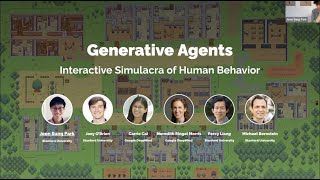
Joon Sung Park | Generative Agents: Interactive Simulacra of Human Behavior
London Machine Learning Meetup · 1:05:28

Which Side of History: How Technology is Reshaping Democracy and Our Lives
Stanford Tech Impact and Policy Center · 59:58
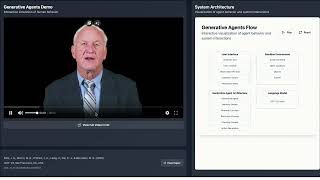
🎥 Exploring Generative Agents: The Future of Human-Like AI Simulations 🌐
AICreative Universe · 8:16