
Video unavailable
This video can't be played right now.
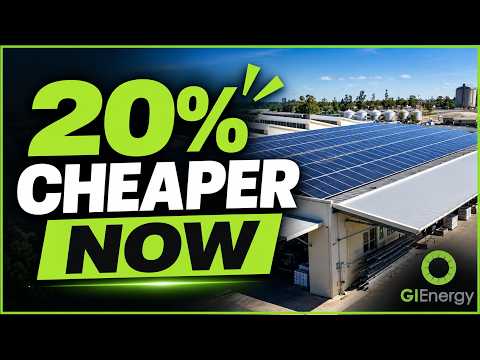
Commercial Solar Just Got 20% Cheaper! Here's What Changed Revised
Commercial solar in Australia just became significantly more affordable! With changes to the Small-scale Renewable Energy Scheme (SRES) from October 2026, eligible businesses can now access upfront solar subsidies for systems up to 1MW, with potential savings exceeding $300,000. In this video, Dan from GI Energy explains Australia's new commercial solar rebate rules, how Small-scale Technology Certificates (STCs) work, and the potential subsidies available for 200kW, 500kW and 1MW solar installations. We also cover the differences between Australia's solar zones, network approval requirements, and why choosing an experienced commercial solar installer is essential. Thinking about commercial solar for your business? GI Energy offers free feasibility studies to help assess your energy usage, infrastructure and potential savings. Have questions? Drop them in the comments below! Chapters 00:00 – Commercial Solar Subsidies: What's Changed? 00:22 – Understanding STCs and the Previous 100kW Limit 00:46 – New Eligibility for Solar Systems Up to 1MW 01:07 – How Commercial Solar Rebates Are Calculated 02:06 – New Rebate Rules and the Fixed 5-Year Period 02:29 – Australia's Four Solar Rebate Zones 02:45 – 200kW Solar System: Upfront Subsidy Examples 03:44 – 500kW Solar System: Potential Savings 04:06 – 1MW Solar System: Over $300,000 in Subsidies 04:53 – Why Rebate Amounts Differ by Location 05:13 – Commercial Solar Design and Network Approvals 06:03 – Installation Timelines and Technical Requirements 06:44 – How to Choose a Reliable Commercial Solar Installer 07:29 – Free Commercial Solar Feasibility Studies Frequently Asked Questions (FAQ) Q: What is the new commercial solar rebate in Australia? Eligible solar systems above 100kW and up to 1MW can now receive upfront support through STCs. Q: How much can businesses save? A 1MW installation could qualify for approximately $308,180 in Zone 1, based on an indicative $38 per certificate. Actual values vary. Q: Will these subsidies decrease every year? Eligible mid-scale solar systems benefit from a fixed five-year STC deeming period through 2030. Q: Do larger commercial solar installations need network approval? Yes. Larger systems require appropriate engineering, system design and network connection approvals. Q: When does the new scheme apply? Eligible installations from 1 October 2026 qualify, with STC applications expected to open in mid-to-late November 2026. Disclaimer: Rebate estimates are indicative and depend on location, STC market values, system specifications and eligibility. #CommercialSolar #SolarRebateAustralia #BusinessSolar #SolarEnergyAustralia #GIEnergy
Suggested videos

NSW's $15,000 Solar & Battery Loan Major Eligibility Changes Announced
GI Energy – No Spin, Just Energy Advice · 4:38

Commercial Solar & Storage: Peak Shaving & Energy Costs | MHHS Ep 5
SUMS Ltd · 1:35

3 Popular Solar Brands We Won’t Install in 2026 and Why
GI Energy – No Spin, Just Energy Advice · 14:03

Think+ Energy Community Solar - How Dual Billing Works! Save 5% - 20% a month for 20+ YEARS! 🔥🔥🔥
Milton Burt, Jr · 1:48

How to Maximise Your Solar and Battery Savings in 3 Minutes
GI Energy – No Spin, Just Energy Advice · 3:13
Is Solar Worth It In 2025?
The DIY HVAC Guy · 15:56
Best Solar Panels part 4: Introduction to performance
GI Energy – No Spin, Just Energy Advice · 0:59
Don’t Buy a Solar Mini Split Until You See This CHEAPER Setup
There's A Trick For That · 17:34

Voted #1 National Solar Installer By SolarQuotes
GI Energy – No Spin, Just Energy Advice · 0:16

Is Solar Worth It ? Go Green and Save Green
Faustin Chopra · 7:57
Best Solar Panels part 5: Introduction to cost
GI Energy – No Spin, Just Energy Advice · 0:47
How To Size A Solar System For Your House! Examples and Calculations
Country Living Experience: A Homesteading Journey · 12:30