
The Collatz Conjecture: The Simplest Math Problem No One Can Solve
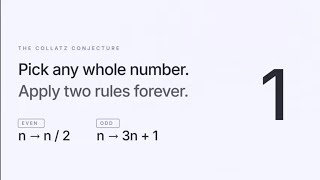
Take any positive integer. If it is even, divide it by two. If it is odd, multiply it by three and add one. Then repeat. These two simple instructions create the Collatz conjecture—one of mathematics’ most famous unsolved problems. In this animated mathematics video, we begin with the number 27 and follow its unpredictable journey through the Collatz sequence. Although the process is completely deterministic, the path rises, falls, and eventually reaches 9,232 before descending toward the familiar 4–2–1 loop. You’ll discover: • How the 3n + 1 rule works • Why the number 27 produces such a long and surprising path • What the repeating 4–2–1 cycle represents • Why extensive computational evidence is not the same as a mathematical proof • How logarithmic charts reveal the structure of Collatz trajectories • What changes when 3n + 1 is generalized to an + b • How neighboring rules can produce different cycles, attractors, and escape behavior • Why crossing a computational threshold does not prove divergence • How a map of rule space reveals cycles and unresolved regions • How reversing the process creates an enormous tree of possible predecessors Computers have tested vast numbers of starting values, and every tested Collatz sequence eventually returns to the same cycle. But testing finite examples can never prove what happens for infinitely many integers. The rule is simple. The evidence is overwhelming. The proof is still missing. #CollatzConjecture #3nPlus1 #Mathematics #UnsolvedProblems #ScienceAnimation
Suggested videos

The Simplest Math Problem No One Can Solve - Collatz Conjecture
Veritasium · 22:09

Simulated Reality
LEMMiNO · 23:16

The REAL Reason Scientists Know We're In A Simulation
The Diary Of A CEO Clips · 22:22
The Collatz Conjecture: The Simple Math Problem No One Can Solve
Trent Smith (Trents Gambit) · 4:01

You’re Not Inside a Simulation — You’re Inside Something Much Stranger
Beyond Reality · 16:23

The Simplest Problem Mathematics Can't Solve
STEM in Motion by Gaurav · 24:43
I’ll Prove It - THE SIMULATION IS REAL
Chase Hughes · 11:35
The Collatz Conjecture Explained: The Simplest Math Problem No One Can Solve
James-Thomas Maloney · 5:50

We Live in a Simulation. The evidence is everywhere. All you have to do is look.
The Why Files · 22:54
UNCRACKABLE? The Collatz Conjecture - Numberphile
Numberphile · 7:52

Unsettling Proof We’re Living in a Simulated Universe
MostAmazingTop10 · 1:26:26
The Simplest Math Problem No One Can Solve (Collatz Conjecture)
Modus Tollens · 4:42