
American Ingenuity - The Brodie Sea Rig
In 1941, the US needed a solution to easily recovering aircraft versus ditching them in the ocean. In 1943, Capt. James Brodie (USAAC), devised a method of using cables and pulley's to safely launch and recover aircraft like the Piper L-4, Stinson L-5 from ships like CVE and freighters. The system that he created, constructed on an LST, enabled an LST to carry, launch, and recover 6 to 10 small planes in addition to carrying a tank deck load of cargo. Before launching, the L-bird would be suspended from a trolley mounted between 2 booms, which would swing clear of the ship's side 40 feet over the water. In launching, the plane runs the length of the trolley and trips a hook release; in recovery, the plane files parallel to the ship, hooking onto a trapeze loop, and is braked to a stop along the trolley. His first sea-based test rig, mounted on the Liberty ship USS City of Dalhart, had First Officer (F/O) Raymond Gregory flying an L-bird as the test pilot, and the system worked perfectly. The "Brodie Sea Rig," as it was later named, was mounted onto LST 776, and was put into wartime use. On Feb. 27, 1945, naval operations at Iwo Jima marked the first time that the Brodie Sea Rig was used for launching and recovering small artillery spotting aircraft (Navy OY-1, which are Stinson L-5s). This system was used a second time at Okinawa in which the L-birds were used in a scouting capacity. Capt. Brodie and F/O Gregory were awarded the Legion of Merit for their actions.
Suggested videos
Commemorative Air Force Capital Wing Christmas Party Slideshow
John Lackey · 7:14
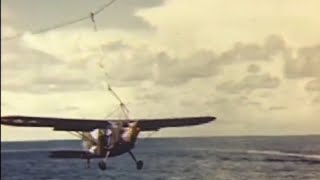
Brodie System
Andrew Palmer · 0:40
Torpedo Squadron No. 8 - Battle of Midway
CAFCapWing - Commemorative Air Force Capital Wing · 7:59
Testing the Brodie Device
Piper Aviation Museum · 4:03
Battle of Midway
CAFCapWing - Commemorative Air Force Capital Wing · 10:56
SkyHook
The Underground Movement · 1:19
Flying the TBF/TBM Avenger
CAFCapWing - Commemorative Air Force Capital Wing · 23:23
Operation "Crossroads"
CAFCapWing - Commemorative Air Force Capital Wing · 4:41
The Fighting Lady: The Lady and the Sea, 1944
CAFCapWing - Commemorative Air Force Capital Wing · 1:01:07
Battle of Midway - Part II
CAFCapWing - Commemorative Air Force Capital Wing · 8:58
Avengers on Mission
CAFCapWing - Commemorative Air Force Capital Wing · 8:54