

Video unavailable
This video can't be played right now.
Google Cloud Armor Rate Limiting: Blocking Layer 7 Flood Attacks
In this deep-dive architectural breakdown, we analyze how modern cyber threats have reached unprecedented scales, highlighted by the August 2023 record-shattering HTTP/2 Rapid Reset distributed denial-of-service (DDoS) attack that peaked at 398 million requests per second (RPS). Unlike legacy Layer 3 and Layer 4 volumetric network floods that attempt to saturate bandwidth with garbage data, Layer 7 flood attacks exploit protocol-level efficiencies—specifically HTTP/2 stream multiplexing—where attackers issue requests and cancel them immediately via RST_STREAM frames. This weaponized behavior bypasses traditional connection limits, generates resource exhaustion on compute backends, and makes requests virtually indistinguishable from legitimate web application traffic. Mitigating attacks of this magnitude requires offloading defense entirely to the network edge before traffic ever touches backend origin servers, Google Kubernetes Engine (GKE) clusters, or virtual machine instances. We explore how Google Cloud Armor provides edge-tier mitigation across global Points of Presence (PoPs) using granular filtering keys, multi-action rate-limiting policies (throttling versus banning), and machine-learning-driven Adaptive Protection that identifies malicious telemetry anomalies and auto-generates surgical WAF rules in real time. Key Technical Takeaways: - Protocol Exploitation & Rapid Reset: Attackers abused HTTP/2 multiplexing mechanisms by initiating thousands of concurrent streams per connection and immediately issuing cancellation frames, flooding application pipelines while evading connection saturation limits. - Edge-Tier Offloading: Filtering layer 7 attacks directly at Google Cloud Armor edge PoPs prevents upstream infrastructure and backend application pools from collapsing under socket exhaustion, memory depletion, or connection table limits. - Precision Filtering Keys: Going beyond ephemeral and easily rotated IP addresses by inspecting JA3/JA4 TLS fingerprints, HTTP headers, request cookies, URI paths, and client region codes to profile malicious client software regardless of proxy or botnet masking. - Throttling vs. Banning Mechanics: Configuring rate limiting policies based on threshold limits (e.g., 2,000 requests per 1,200-second interval window) combined with exceed behaviors like HTTP 429 (Too Many Requests), reCAPTCHA challenges, or rate-based enforcement bans enforcing time-outs (e.g., 3,600-second ban durations). - Automated Adaptive Protection Pipeline: Utilizing built-in machine learning models that establish baseline traffic profiles, detect high-volume anomalies, extract precise attack signatures (User-Agent strings, URI endpoints, region codes), and automatically deploy targeted mitigation rules. - Defense-in-Depth Implementation: Staging WAF rules in preview mode to log would-be blocked telemetry without risking false positives, followed by cascading baseline OWASP/SQLi WAF rules, rate limiting, and ML-assisted heuristics into production policies. Video Chapters: 00:00 - The 398 Million RPS DDoS Milestone 00:25 - Inside the HTTP/2 Rapid Reset Attack 01:23 - Anatomy of Layer 7 Flood Attacks 02:21 - Cloud Armor Edge Defense & Filtering Keys 03:29 - Rate Limiting: Throttling vs. Banning 04:38 - ML-Powered Adaptive Protection 05:44 - Building an Enterprise Defense-in-Depth Strategy 06:23 - Preparing for the Next Exponential Attack Leap Subscribe to Cloud Explainers (@cloudexplainers) for enterprise architecture reviews, multi-cloud security breakdowns, and hands-on infrastructure engineering guides. Share your experiences and questions on configuring Cloud Armor policies and Layer 7 protection in the comments below! #GoogleCloud #CloudArmor #CyberSecurity #DDoSProtection #CloudSecurity #DevOps #SRE #InfraSec
Suggested videos

Everything You Want to Know About Clouds
StarTalk · 11:15
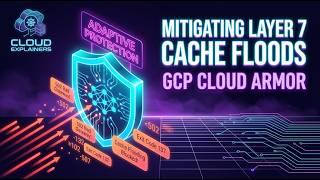
GCP Cloud Armor Adaptive Protection: Mitigating Layer 7 Cache Floods
Cloud Explainers · 9:29
Cloud Computing in 2 Minutes
Codebagel · 2:42
DDoS Attack Mitigation Explained Through a Chaotic Restaurant Dinner Rush
Taistek · 30:18

Architecting the Digital Future: Utilizing a Cloud Platform | CLOUD COMPUTING Explainer
My Notes with ai · 6:47
Google Cloud Digital Leader Full Course 2026: Free Exam Prep, New Guide (21 Lessons, 141 Questions)
Cert Espresso · 3:04:53

Enterprise Solution Explainer Video: JOS VDI Cloud Computing | Premium Animation
What a Story - The Video Partner for SaaS & AI · 1:39

Mocked as a Newbie, He Uses Music to Shock an Entire Empire into Kneeling Before Him
Inosuke Recapz · 13:08:56
Managing Cloud Infrastructure vs Cloud Applications | CLOUD COMPUTING Explainer
My Notes with ai · 6:40

You Were Taught to Work Hard. You Were Never Taught THIS!
Evan Carmichael · 3:20:56
Cloud Applications and Management | CLOUD COMPUTING Explainer
My Notes with ai · 6:33

250 BORING FACTS THAT MAKE IT EASY TO FALL ASLEEP
КНИГИ, ИСТОРИИ, ФАКТЫ · 1:47:09