
Video unavailable
This video can't be played right now.
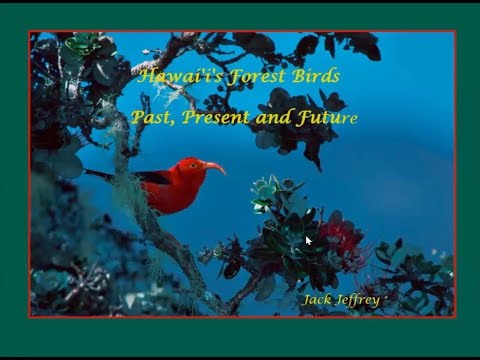
Hawai'i's Forest Birds Past, Present and Future
Hawaiian endemic forest birds and their precarious future. Jack Jeffrey 6/5/2022 The Hawaiian Archipelago is the most isolated chain of islands in the world, over twenty-five hundred miles from the nearest continent. Very few plants and animals have ever reached these remote islands on their own, but those that did, evolved over time and became unique to the Islands. About five and a half million years ago, a small flock of finch like birds from Asia, likely blown off course, arrived in the Hawaiian islands. Unrestricted food supplies and adaptations through competition for these food resources created evolutionary opportunities for speciation through specialization of bill forms and body size. From this one colonization the Hawaiian Honeycreepers evolved into over fifty different bird species found nowhere else on earth. Some Honeycreepers, like the scarlet I’iwi, evolved long curved bills to feed on nectar in the curved flowers of native plants, like those of the Bell flower family or Lobelias and provide for their pollenation. Other bird species adapted to feed on insects in different ways. For example, the tiny Hawaii Akepa, with its short straight bill, crossed at the tip, gleans micro insects from leaf buds. The Akialoa’s long thin bill, almost as long as its body, was used to poke deep into tree crevices to find insects that no other bird could reach. The Akiapola’au has one of the most unusual bills in the bird world. Its upper bill is long, thin and down curved, and lower bill short straight and stout feeds like a woodpecker, but with its mouth open. It pecks into the tree wood with its lower short-stout bill, then uses the upper long curved bill to reach into the hole to wrench out wood-boring beetle larvae. Today, only 17 Hawaiian Honeycreepers species remain in the Islands, but with continued habitat protection and restoration as is happening at Hakalau Forest NWR on Hawaii Island and other areas in the State, as well as captive breeding and release, and active research on control of mosquitos and avian diseases, the remaining Hawaiian Honeycreepers will hopefully survive far into the future.
Suggested videos
fresno audubon society.wmv
SevagTateosian · 2:42

2024: A Year of Struggles and Hope for Hawaii’s Forest Birds
Big Island Thieves · 3:20

Audubon Court Apartments in Fresno, CA - ForRent.com
ForRent.com · 1:31

Forests for Life: Saving the Birds of Hawaii
KHON2 News · 6:17

Fresno 4k Tour – Alluvial Avenue and Audubon Drive - Winter
Alexander’s Drives · 29:37

Hawaii's Forest Birds: The fight for survival. Avian malaria and mosquito research.
Travis DuBridge | Wildlife & Science · 21:28
Gary Woods Bird Photography 2020
FresnoAudubon · 51:12
Intro to Hawaii's Forest Birds: Avian Malaria and Mosquito Research (Documentary)
Kauai Forest Bird Recovery Project (KFBRP) · 2:07

3 Months of Madness: Fresno’s Most Chaotic Intersection
Friant Roulette · 6:30
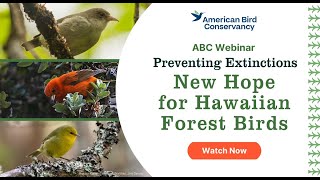
Preventing Extinctions: New Hope for Hawaiian Forest Birds | ABC Webinar
American Bird Conservancy · 1:01:04

116 E Audubon Dr. Fresno CA
Alejandro Lopez Realtor · 1:01

DLNR & YOU Endangered Forest Birds of Hawaii HD
Hawaii Dept. of Land and Natural Resources (DLNR) · 4:54