
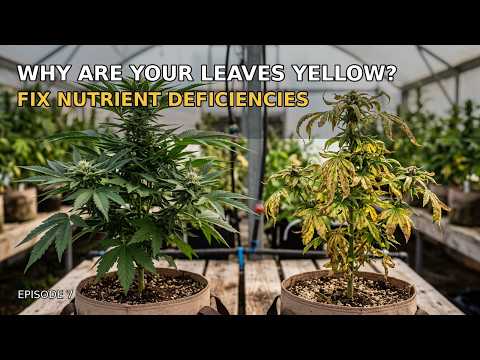
Video unavailable
This video can't be played right now.
Why Are Your Leaves Turning Yellow? 7 Nutrient Deficiencies Explained
A yellow leaf does not automatically mean you need more fertilizer. The real cause may be a nutrient shortage, pH-related lockout, excess salts, damaged roots, poor drainage, temperature stress, pests, disease, or normal aging. In Episode 7 of The Organic Grow Roadmap, we break down the most common nutrient deficiencies cannabis growers encounter and show what each pattern can suggest, what usually causes it, how to recover without creating a second problem, and how to prevent it from returning. You will learn how to recognize and investigate nitrogen, phosphorus, potassium, calcium, magnesium, iron, and sulfur deficiency patterns; why purple stems are not proof of phosphorus deficiency; why brown leaf margins can also point to salt or root stress; why young-leaf chlorosis and older-leaf chlorosis lead to different hypotheses; and why pH, EC, drainage, root oxygen, water quality, and nutrient antagonism matter before you reach for a rescue bottle. The most important lesson is simple: a symptom is a clue, not a diagnosis. The strongest practical workflow is to inspect the whole plant and roots, measure the root zone with a method appropriate for the medium, review the water and feeding history, and use tissue or laboratory testing when symptoms are severe, mixed, or not responding. This episode is educational information for adults who are legally permitted to cultivate in their jurisdiction. Follow all applicable laws, product labels, and local safety requirements. This is not a substitute for a qualified horticultural or laboratory diagnosis. Chapters 00:00 The symptom is not the diagnosis 02:09 Check the root zone first 04:21 Nitrogen deficiency: older leaves pale 07:04 Phosphorus and potassium: purple clues and burnt margins 09:14 Calcium and magnesium: new growth versus green veins 11:22 Iron and sulfur: two different chlorosis patterns 13:14 CTA and the same symptom, different cause 14:13 Prevention, recovery, and the final rule Research and further reading [1] Utah State University Extension, “Nutrient Deficiencies.” Symptoms, monitoring, soil and foliar testing, and management notes for hemp production. https://extension.usu.edu/pests/ipm/notes_ag/hemp-nutrient-deficiencies [2] Cockson, P. et al., “Characterization of Nutrient Disorders of Cannabis sativa.” Applied Sciences, 2019. Controlled symptom and foliar-concentration study covering nitrogen, phosphorus, potassium, calcium, sulfur, magnesium, and micronutrients. https://www.mdpi.com/2076-3417/9/20/4432 [3] Pacific Northwest Plant Disease Management Handbook, “Plant Nutrition Diagnosis.” Why visual diagnosis can be inaccurate, why soil and tissue tests complement one another, and how container growers can use pour-through pH and EC checks. https://pnwhandbooks.org/plantdisease/pathogen-articles/nonpathogenic-phenomena/plant-nutrition-diagnosis [4] Hershkowitz, J. A., Westmoreland, F. M., and Bugbee, B., “Elevated root-zone P and nutrient concentration do not increase yield or cannabinoids in medical cannabis.” Frontiers in Plant Science, 2025. https://www.frontiersin.org/journals/plant-science/articles/10.3389/fpls.2025.1433985/full [5] “Sulfur deficiency in Cannabis sativa” study, Plants, 2023. https://www.mdpi.com/2223-7737/12/3/422 [6] Montana State University Extension, “Nutrient Deficiency.” Practical symptom and diagnosis reference. https://landresources.montana.edu/soilfertility/nutrientdeficiency.html [7] University of Missouri Extension, “Plant Nutrient Deficiency Diagnosis.” https://extension.missouri.edu/publications/g9069
Suggested videos
COMMON PESTS: Identify, Control & Prevent Spider Mites, Thrips, Gnats & Aphids
The Organic Gardener's Lab · 12:19

How to Fix Yellow Leaves - Nitrogen, Magnesium, Sulfur & Potassium Deficiencies in Weed & Cannabis
How Weed Grow at Home - Indoor Cannabis Tutorials · 7:41
Spotting Common Nutrient Deficiencies By Understanding The Subtleties Of Leaf Chlorosis
Chad's Grow Room · 8:45
Colombian Gold Was Never Just One Plant
The Organic Gardener's Lab · 10:38
Nutrient Deficiencies In Plants - What You Need To Know
Geeky Greenhouse · 7:12
The Vegetative Stage Decides Your Harvest - Light, Training, and Feeding Without Guesswork
The Organic Gardener's Lab · 6:05
How to FIX Yellow Leaves - Why it Happens to Plants
Fast Gardening Michigan · 4:33
The Drying & Curing Mistake That can Ruins a Great Harvest
The Organic Gardener's Lab · 9:42
How to Identify & Fix the 5 Most Common Nutrient Deficiencies in Plants
Chris The Amateur Gardener · 2:10
TOPPING Plants 🌱 Does It REALLY Increase Yields? The Science Explained!
The Organic Gardener's Lab · 7:03
Nutrient Deficient (Yellowing Leaves) Bean Fix – This Week in the Garden
Family Plot Garden · 1:13
FAR-RED, UV & UNDER-CANOPY LIGHTING: What Actually Works for Cannabis?
The Organic Gardener's Lab · 9:16