
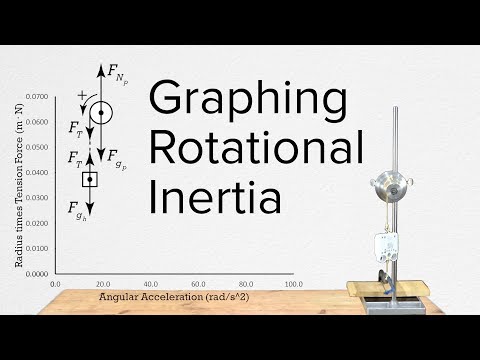
Video unavailable
This video can't be played right now.
Graphing the Rotational Inertia of an Irregular Shape
We determine what data to collect to create a graph with rotational inertia as the slope of the best-fit line: the net torque exerted on a rotating irregular shape (found via a hanging mass and pulley) is graphed against the resulting angular acceleration, since Στ = Iα means the slope of that line is the rotational inertia I. #rotationalinertia - Then we collect the data and determine the rotational inertia of an irregular shape. Want Lecture Notes? https://www.flippingphysics.com/graphing-rotational-inertia.html 0:00 Intro, and the Problem 0:46 Free Body Diagram, and Net Torque 3:01 Trial #1, and Angular Acceleration 5:20 12 Trials and Graph, and Deriving Units Next Video: How the Force of Tension on a Pulley Changes with Acceleration https://www.flippingphysics.com/pulley-tension-force.html Want a Rotational Inertia Demonstrator? https://www.arborsci.com/rotational-inertia-demonstrator.html Previous Video: Painter on a Scaffold - Don't Fall Off!! https://www.flippingphysics.com/painter-scaffold.html Please support me on Patreon! http://patreon.com/FlippingPhysics Thank you to Christopher Becke and Faiaz Rahman for being my Quality Control Team for this video. http://flippingphysics.com/quality-control.html Thank you to Jonathan Sullivan-Wood for transcribing the English subtitles of this video. #RotationalInertia #MomentOfInertia #Graphing Curriculum Standards: AP Physics 1 & C: Mechanics, Unit 5 Torque and Rotational Dynamics, Topic 5.3 Torque 5.3.A.1: "Torque results only from the force component perpendicular to the position vector from the axis of rotation to the point of application of the force." 5.3.A.2: "The lever arm is the perpendicular distance from the axis of rotation to the line of action of the exerted force." AP Physics 1 & C: Mechanics, Unit 5 Torque and Rotational Dynamics, Topic 5.6 Newton's Second Law in Rotational Form 5.6.A.2: "The rate at which the angular velocity of a rigid system changes is directly proportional to the net torque exerted on the rigid system and is in the same direction. The angular acceleration of the rigid system is inversely proportional to the rotational inertia of the rigid system." α_sys = Στ/I_sys = τ_net/I_sys. AP Physics 1 & C: Mechanics, General Skills - Science Practice 1 (Creating Representations) N/A (Skill 1.A) [Data Tables]: "Create diagrams, tables, charts, or schematics to represent physical situations." N/A (Skill 1.B) [Creating Graphs]: "Create quantitative graphs with appropriate scales and units, including plotting data." Cambridge International A Level Physics (9702), Practical Assessment N/A (Practical Skills) [Plotting Points]: "plot all their data points on their graph grid to an accuracy of better than 1 mm." N/A (Practical Skills) [Trend Line]: "draw straight lines of best fit or curves to show the trend of a graph." IB Physics, Tool 3: Mathematics - Graphing Tool 3 (Graphing): "Interpret features of graphs including gradient, changes in gradient, intercepts, maxima and minima, and areas under the graph." JEE Main & NEET, Unit 5 Rotational Motion "Basic concepts of rotational motion, moment of a force, torque, angular momentum, conservation of angular momentum and its applications." NGSS, Science and Engineering Practices N/A (SEP) [Analyzing and Interpreting Data]: "Analyze data using tools, technologies, and/or models (e.g., computational, mathematical) in order to make valid and reliable scientific claims or determine an optimal design solution." Ontario Physics (SPH3U), Strand A Scientific Investigation Skills and Career Exploration A1.6: "compile accurate data from laboratory and other sources, and organize and record the data, using appropriate formats, including tables, flow charts, graphs, and/or diagrams." Gaokao, Core Competencies - 科学探究 (Scientific Inquiry) N/A (Core Competency) [Scientific Inquiry]: "'Scientific Inquiry' refers to the ability to propose physics questions based on observation and experimentation, form conjectures and hypotheses, design experiments and formulate plans, acquire and process information, draw conclusions based on evidence and provide explanations, and to communicate, evaluate, and reflect on the process and results of scientific inquiry." MCAT, Scientific Inquiry and Reasoning Skills - Skill 4: Data-Based and Statistical Reasoning "Interpreting patterns in data presented in tables, figures, and graphs."
Suggested videos

The Monetary Reality of Flipping Physics
Flipping Physics · 1:49
Moment of Inertia For Slender Rod - Formula Derivation Via Integration Physics With Calculus
The Organic Chemistry Tutor · 19:32
AP Physics 1 - Unit 3 Review - Work, Energy, and Power - Exam Prep
Flipping Physics · 18:39
Solving For the Moment of Inertia of an irregular Shape
After Math Tutoring · 39:25
AP Physics 1 - Unit 2a Review - Newton's Laws and Forces - Exam Prep
Flipping Physics · 21:07

Rotational motion graphs
Joseph Foti · 5:33

I Auditioned for Survivor! (again) Here Is My 60-Second Pitch
Flipping Physics · 1:58
Understanding the Area Moment of Inertia
The Efficient Engineer · 11:05

AP Physics 1 - Unit 1 Review - Kinematics - Exam Prep
Flipping Physics · 23:53
Statics: Lesson 70 - Area Moment of Inertia, Calculus Method
Jeff Hanson · 7:43
An Introductory Tension Force Problem
Flipping Physics · 8:59

Moment of Inertia of Regular Shapes
LearnEveryone · 1:48