
Flight 15: SpaceX Starship Catch, Explained
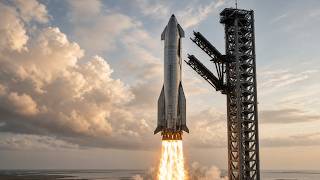
SpaceX Starship catch: SpaceX just caught a 52-metre rocket ship out of the sky with a giant tower — the first time any spacecraft has been caught after coming back from orbit. Starship Flight 15 launched on Friday, November 13, 2026, at 5:47 PM ET from Starbase, Texas. The upper stage — Ship 42 — spent about 22.5 hours in orbit, circled the Earth 14 times, and deployed 26 Starlink V3 internet satellites. Then, on Saturday, November 14, at about 4:20 PM ET, it came home: it fell back through the atmosphere belly-first, flipped upright, fired three Raptor engines to slow down, and slid between the two arms of the launch tower — nicknamed Mechazilla, or the chopsticks — which closed around fittings near the top of the ship. SpaceX's own words: "Mechazilla catches Starship!" The ship alone stands 52 metres tall — about 17 storeys. The full rocket is about 124 metres, taller than the Saturn V moon rocket, and the tower that caught it is about 146 metres tall. The arms do three jobs: they stack the rocket, hold it steady, and now catch it. The catch works because Starship has no landing legs — on purpose. Legs strong enough to hold a 52-metre ship would weigh several tonnes, dead weight carried all the way to orbit for 30 seconds of use. Catching moves that weight into the tower, which never leaves the ground, and the tower can put the ship straight back on a booster. Falcon 9 has landed on legs since 2015 and flown more than 700 times, but its second stage is thrown away after every flight. Starship is meant to reuse both halves — the key to cheaper launches, more Starlink satellites, and the Moon missions NASA is counting on. NASA Administrator Jared Isaacman called the catch "almost magic" and "one step closer to the Moon." SpaceX's livestream even played "Baby Come Back" as the ship came home. The honest part: only one of the two catches worked. The Super Heavy booster was supposed to be caught minutes after launch, but it detected a guidance and navigation problem on the way back, the catch was called off automatically, and it splashed down in the Gulf of Mexico. The booster has been caught three times before — on Flights 5, 7 and 8 — but the ship had never been caught until now. And a catch does not yet prove the ship can fly again without major work. Chapters: 00:00 The catch 00:07 What you will know 00:17 The flight 00:26 The mission 00:32 The first ever 00:39 What is Starship? 00:47 The booster 00:54 How big is it? 01:04 How the catch works 01:12 The final seconds 01:20 Mechazilla catches Starship 01:31 The tower 01:41 The reset: the booster 01:48 Booster down in the Gulf 01:58 The scoreboard 02:09 Why catch at all? 02:15 Weight 02:25 Move the weight to the ground 02:33 The whole point 02:41 Falcon 9 vs Starship 02:51 Why NASA is watching 03:02 Still a long way to go 03:12 One for two 03:21 What next? Sources: The Week (Nov 15, 2026); USA Today (Nov 14, 2026); Indian Express / Reuters (Nov 15, 2026); The Statesman (Nov 15, 2026); SpaceX Flight 15 webcast and post on X (Nov 14, 2026).
Suggested videos
🇺🇸 SpaceX Starship Flight 15 Attempt to Catch Spacecraft after Yesterday Failure [LIVE]
MAGNO NEWS · 1:05:59

China hacking America’s critical infrastructure, retired four-star general warns | 60 Minutes
60 Minutes · 13:24

SpaceX Launches Starship Flight 15
C-SPAN · 23:05

America’s Crumbling Infrastructure | 60 Minutes Archive
60 Minutes · 14:09

🔥 SpaceX & Starlink Teams Go Crazy as Starship Flight 15 is Caught Mid-Air after 22-Hour Flight
MAGNO NEWS · 5:56

This Bridge Collapsed In Minutes | Plainly Difficult
Plainly Difficult · 11:07

Starship Flight 15: Starship Reentry & Catch!
What about it!? · 11:55:00

"60 Minutes" investigates risky infrastructure
CBS Mornings · 4:57

SpaceX Starship Flight Test 15: Everything That Happened in 12 Minutes
CNET · 12:33

Terraform, Explained: Infrastructure from a Blueprint
Ten Minutes Smarter · 7:31
Watch SpaceX Attempt to Catch Starship For The First Time! - Commentary
Avid Space · 4:16:51

Mastering IT Infrastructure Management - Essentials and Best Practices (20 Minutes)
Microlearning Daily · 19:25