
Video unavailable
This video can't be played right now.
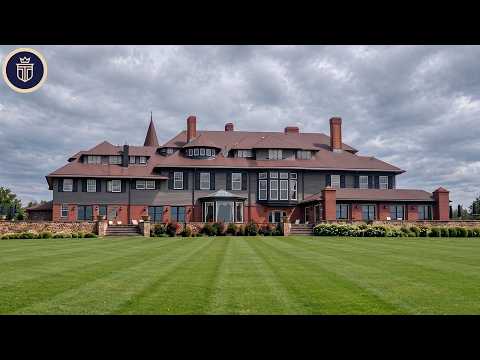
Inside the Newport Farm Where Jackie Kennedy Grew Up and Married JFK: Hammersmith Farm
In this video, we explore Hammersmith Farm, the 28-room shingled house on a hill above Narragansett Bay where Jacqueline Bouvier spent her girlhood summers, celebrated her wedding to John F. Kennedy in 1953, and later returned as First Lady to the summer White House, before her mother's world was sold off one building at a time. ------------------- Gain FREE access to secret full-length documentaries on wealthy families "too scandalous for YouTube" by joining our newsletter: https://www.substack.com/@oldmoneyluxury ------------------- The land was first farmed in 1640 by William Brenton, a surveyor and future governor of Rhode Island, who named it after Hammersmith on the Thames. In 1887 John Winthrop Auchincloss bought it and raised a 28-room house of gray shingle, deep porches and steep gables. Ten years later he sold it to his brother Hugh, whose wife, Emma, was the daughter of Oliver Burr Jennings, one of the founding shareholders of Standard Oil. Emma called in the Olmsted Brothers, the firm founded by the family behind Central Park, and they worked on the grounds on and off until 1946, shaping lawns that ran down to the bay and gardens that still cover about forty acres. Unlike the marble palaces on Bellevue Avenue, Hammersmith remained a working farm, with Guernsey cows, horses and fields running to the water. Their son, Hugh D. Auchincloss Jr., known as Hughdie, was born on the farm in 1897. A stockbroker with a second estate, Merrywood, in Virginia, he married Janet Lee Bouvier in 1942, and her daughters, Jacqueline and Lee, arrived at Hammersmith. Jackie was given a bedroom of her own that she would keep for most of her life. During the war, the farm supplied the naval station, and family lore says she fed two thousand chickens. On September 12, 1953, Jackie married Senator John F. Kennedy at St. Mary's Church on Spring Street in Newport, on the arm of her stepfather. Thousands of onlookers crowded the streets. Then the motorcade drove up the hill to Hammersmith for a reception planned for more than twelve hundred guests. A gale blew off the bay, lifting tablecloths and the pink taffeta skirts of ten bridesmaids. The couple stood in the receiving line for more than two hours, danced to I Married an Angel under Meyer Davis's canopy on the terrace, and cut a four-foot cake from a Fall River bakery whose owner Kennedy had promised the job years earlier. Then the bride climbed the main staircase and threw her bouquet. From 1961 to 1963, Hammersmith Farm became the summer White House, with a presidential flag flying over the house. Janet and Hughdie moved down to a small yellow farmhouse the children called the Castle so the Kennedys could have the house to themselves. In the Deck Room, with a daiquiri in hand, the president called the view the most beautiful site on the East Coast. In September 1963 the Kennedys spent their tenth anniversary there, a month after the death of their infant son, Patrick. On their last weekend the Walsh Family Singers performed in the Deck Room, and the president staged a comic spy film in which he lay in the foyer covered in ketchup. Two months later he was killed in Dallas. In 1967 Hughdie built Janet a hundred-foot shingled windmill guesthouse based on Jackie's sketch. But the oil money was thinning. The main house went dark in 1974, Hughdie died in 1976, and in 1977 Janet sold the house and about fifty acres to a group that opened it as a museum. She kept the Castle, the Windmill and a former garage the family called the Palace, and she died at Hammersmith in 1989 with Jackie and Lee at her side. In 1995 the museum's owners put the farm on the market, and in 1997 it was sold to William Farley of Fruit of the Loom. In 1999 the Goldman Sachs banker Peter Kiernan bought the main house for a little over eight million dollars and found a ruin. The plumbing had failed, bricks dropped from the walls each winter and the whole house leaned toward Fort Adams. One end was taken off for new steel supports, and every molding was numbered and returned to its place. Today Hammersmith Farm is closed to the public. Sheep and horses graze in the fields again, and tour boats still slow down offshore so passengers can photograph the gray house on the hill. It is the story of a working farm built on an oil fortune, the girl who grew up there and the president who loved its view, and the family that could no longer afford to keep it. Subscribe to Old Money Mansions for the stories behind extraordinary houses, inherited fortunes, and the families whose lives shaped them. Share your thoughts in the comments: should Hammersmith Farm be open to the public as part of the Kennedy story? #HammersmithFarm #JackieKennedy #OldMoneyMansions
Suggested videos
The Dark Story Behind the Rothschilds’ Waddesdon Manor “Old Money” Mansion
Grand Manors · 1:44:31
A Visit to Hammersmith Farm (part 1)
Robert Westover · 0:44
Inside The Kennedy Family's "Old Money" Mansions
Old Money Mansions · 21:43
Jackie Kennedy Onassis: Inside Her Many Mansions
This House · 16:20
The FORGOTTEN Story of The Frick Mansions That Defied America's Hatred | Documentary
Old Money Dynasty · 1:14:02

CANDID KENNEDY FILM -- NEWPORT, RHODE ISLAND (SEPTEMBER 12-15, 1963)
David Von Pein's JFK Channel · 20:46
How Columbus's Old Money Built a Village of Mansions and Then Walled Itself In: Bexley
Ohio Uncovered · 28:03
CANDID KENNEDY FILM -- CAMP DAVID (MARCH 31, 1963)
David Von Pein's JFK Channel · 8:31
Top 10 Must See "Old Money" MANSIONS in CALIFORNIA
Old Money Mansions · 20:11
'Scandalous' Season 3 Premiere: The William Kennedy Smith Trial
Biển Đông · 1:35
The Mansions That Built The British Aristocracy (Documentary)
Old Money Documentaries · 2:32:20
Inside The Mansions The Royal Family Paid For To Keep The Duke of Windsor Silent
Old Money Mansions · 1:08:59