
A Stealthier Partitioning Attack against Bitcoin Peer-to-Peer Network
A Stealthier Partitioning Attack against Bitcoin Peer-to-Peer Network—Muoi Tran, Inho Choi, Gi Jun Moon, Anh V. Vu, Min Suk Kang Network adversaries, such as malicious transit autonomous systems (ASes), have been shown to be capable of partitioning the Bitcoin’s peer-to-peer network via routing-level attacks; e.g., a network adversary exploits a BGP vulnerability and performs a prefix hijacking attack (viz. Apostolaki et al. [3]). Due to the nature of BGP operation, such a hijacking is globally observable and thus enables immediate detection of the attack and the identification of the perpetrator. In this paper, we present a stealthier attack, which we call the EREBUS attack, that partitions the Bitcoin network without any routing manipulations, which makes the attack undetectable to control-plane and even to data-plane detectors. The novel aspect of EREBUS is that it makes the adversary AS a natural man-in-the-middle network of all the peer connections of one or more targeted Bitcoin nodes by patiently influencing the targeted nodes’ peering decision. We show that affecting the peering decision of a Bitcoin node, which is believed to be infeasible after a series of bug patches against the earlier Eclipse attack [29], is possible for the network adversary that can use abundant network address resources (e.g., spoofing millions of IP addresses in many other ASes) reliably for an extended period of time at a negligible cost. The EREBUS attack is readily available for large ASes, such as Tier-1 and large Tier-2 ASes, against the vast majority of 10K public Bitcoin nodes with only about 520 bit/s of attack traffic rate per targeted Bitcoin node and a modest (e.g., 5–6 weeks) attack execution period. The EREBUS attack can be mounted by nationstate adversaries who would be willing to execute sophisticated attack strategies patiently to compromise cryptocurrencies (e.g., control the consensus, take down a cryptocurrency, censor transactions). As the attack exploits the topological advantage of being a network adversary but not the specific vulnerabilities of Bitcoin core, no quick patches seem to be available. We discuss that some naive solutions (e.g., whitelisting, rate-limiting) are ineffective and third-party proxy solutions may worsen the Bitcoin’s centralization problem. We provide some suggested modifications to the Bitcoin core and show that they effectively make the EREBUS attack significantly harder; yet, their nontrivial changes to the Bitcoin’s network operation (e.g., peering dynamics, propagation delays) should be examined thoroughly before their wide deployment.
Suggested videos

Opening Remarks of the 2016 IEEE Symposium on Security & Privacy
IEEE Symposium on Security and Privacy · 9:32

A Stealthier Partitioning Attack against Bitcoin Peer-to-Peer Network
IEEE Symposium on Security and Privacy · 1:00

IEEE S&P 2022 Opening Session
IEEE Symposium on Security and Privacy · 51:36
A Stealthier Partitioning Attack against Bitcoin Peer to Peer Network by Muoi Tran
CS Research Week · 16:25

Privacy Research Panel, 2013 IEEE Symposium on Security and Privacy
NITRD Program · 1:23:46
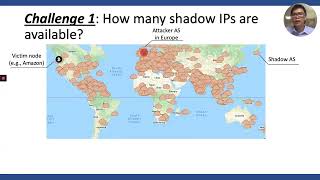
A Stealthier Partitioning Attack against Bitcoin Peer to Peer Network
All Hacking Cons · 16:25

IEEE S&P 2019—40th IEEE Symposium on Security and Privacy—Closing Remarks
IEEE Symposium on Security and Privacy · 11:42

USENIX Security '15 - Eclipse Attacks on Bitcoin’s Peer-to-Peer Network
USENIX · 27:15

IEEE S&P 2023 Short Talks
IEEE Symposium on Security and Privacy · 45:21
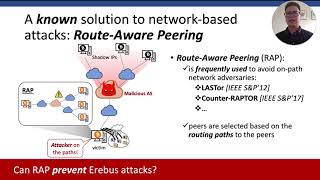
USENIX Security '21 - On the Routing-Aware Peering against Network-Eclipse Attacks in Bitcoin
USENIX · 11:49

Ethics in Security and Privacy Research Panel
IEEE Symposium on Security and Privacy · 49:41

Erebus Attacks And How To Stop Them With ASMAP
Bitcoin Magazine · 16:01