
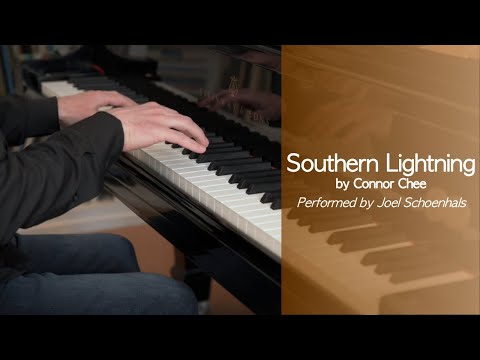
Video unavailable
This video can't be played right now.
Sandpainting for Piano No. 7: Southern Lightning by Connor Chee
Sandpainting for Piano No. 7: Southern Lightning from Sandpaintings for Piano (2021) by Connor Chee Performed by pianist Joel Schoenhals www.connorchee.com www.joelschoenhals.com Video production: www.gregknollmeyer.com Sheet music: https://www.wildsaguarorecords.com/online-store/Digital-Sheet-Music-Sandpaintings-for-Piano-Connor-Chee-p454949991 Sandpaintings for Piano (2021) by Connor Chee was commissioned by pianist Joel Schoenhals and is a forty-five minute work that includes four sets of four pieces. “When composing the music for my album Scenes from Dinétah, I knew that I wanted to have a visual aspect to the album through a series of music videos. Along the same lines of that visual inspiration, I decided to refer to some traditional Diné visual art for this commission: sandpaintings. Sandpaintings are created by carefully sprinkling different colored sand to create paintings. Traditionally, they serve a curative purpose, and are used in a variety of ceremonies. Unlike the Diné sandpaintings one might see displayed for aesthetic and artistic purposes, the healing sandpaintings contain sacred elements, and they exist only during the ceremony. I feel a strong parallel with music here, in that they only exist while the ritual is performed. While there are sacred sandpaintings that should not be used or created outside of ceremony, I took inspiration from several common elements in sandpaintings: sacred stones, clouds, lightning, and the sacred mountains. The number four is sacred to the Diné, and this is often related to the four directions. In that sense, many sandpaintings will depict elements four times—once in each direction. In the traditional dwelling (known as a hogan), the door always faces East to greet the rising sun. When entering, you must always move clockwise around the center of this circular dwelling. Some sandpaintings share this format, having a circle with an opening towards the east, and the sandpaintings within shown in each of the four directions. For this reason, Sandpaintings for Piano begins with four pieces based on the Eastern direction and continues clockwise to the South, West, and finally the North. I composed the subjects for the Northern direction first and derived the content for each direction from those original themes. Each piece in the Eastern direction is an inversion of the original Northern themes. Each work in the Southern direction is a retrograde inversion, and each work in the Western direction is a retrograde. Thus, the theme for each piece is carefully related to its counterparts in each direction. Just as a sandpainting might depict a mountain in each direction that rotates as it is drawn, these musical pieces have the same theme that “rotates'' through this series of permutations. Each piece's melody is also the reflection of the piece opposite if placed in a circle with four directions. Thus, pieces in the Eastern and Western directions are retrograde inversions of each other and pieces in the Southern and Northern directions are retrograde inversions of each other. Finally, the melodies are presented in their original and complete form in the Northern direction. In this sense, once the music has been played to completion from East to North, each theme has found balance in its true form - just as traditional sandpaintings serve to bring balance to life.” - Connor Chee Beyond four sets of four pieces, the number four permeates Sandpaintings, just as it does Navajo life and philosophy. Within each piece, this symbolism expresses as four repetitions of a subject, each cast in a different texture, four repetitions of chords as frames to begin and end pieces, and harmonies built on fourths and the inversion fifths. Chee paints with music, using recurring motives to characterize each sacred element. The sacred stones pieces each begin with a unison chant. Cloud pieces feature tone clusters and rain-like improvisatory passages. Striking gestures and dotted rhythms musically paint lightning. Block chords and minimalistic textures symbolize mountains. Through these methods, Chee organically balances unity and variety within this large-scale work. Special thanks to the donors and organizations who made this commission possible: Charles Yoder, John Hogikyan and Barbara Kaye, Amy Horst, Allana Frear, Fred and Laurie Blum, Tracey Baetzel, Kyung Kim, Henry Buchtel and Margaret Evans, Gale Kramer and Jeff Chase, Joel Howell and Linda Samuelson, Bob Weisman, Rick Cieslak, Bernie and Barb Banet, Pamela and Steve Ruiter-Feenstra, James Shields and Sheryl Burke, Joel Schoenhals and Bing Li, Anonymous, Ann Arbor Area Piano Teachers Guild Foundation, Music Teachers National Association Teacher Enrichment Grant.
Suggested videos
Connor Chee: Sandpainting for Piano No. 7: Southern Lightning from Sandpaintings for Piano (2021)
Joel Schoenhals · 1:58

Conversemos sobre el piano, entrevista Dr. Joel Schoenhals, EMU
Andres Gomez-Bravo · 52:43

Joel Schoenhals, piano – Beethoven: The Final Sonatas, Op. 109, 110 & 111
Kerrytown Concert House · 1:31:18
Sandpainting for Piano No. 7: Southern Lightning
Connor Chee - Topic · 1:58

Franz Schubert: Allegretto in C Minor, D. 915 with Lecture
Joel Schoenhals · 8:07

Sandpainting for Piano No. 3: Eastern Lightning by Connor Chee
Joel Schoenhals · 3:31

Connor Chee: 16 Etudes for Piano (World Premiere) Joel Schoenhals, piano
Joel Schoenhals · 1:38:59
Connor Chee: Sandpainting for Piano No. 9: Abalone from Sandpaintings for Piano (2021)
Joel Schoenhals · 3:10

The North Wind is Blowing (arr. Yin Chengzong for piano)
Joel Schoenhals · 3:36

Sandpainting for Piano No. 10: Western Clouds by Connor Chee
Joel Schoenhals · 3:09

Franz Schubert: Hungarian Melody in B Minor, D. 817 with Lecture
Joel Schoenhals · 13:49

Sandpainting for Piano No. 9: Abalone by Connor Chee
Joel Schoenhals · 3:08