
Video unavailable
This video can't be played right now.
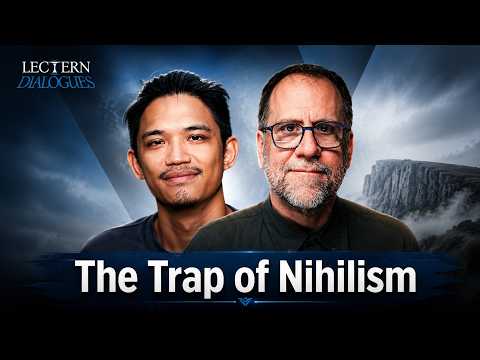
Nihilism Is Not the End | John Vervaeke & Ethan Hsieh (Part 2/3)
What if nihilism is not just something to reject, but something you have to grieve deeply enough to see through? In Part 2 of this Lectern conversation, John Vervaeke joins Ethan Hsieh to continue exploring *Notes on No-Thing*, a course on the Kyoto School of Philosophy and its response to nihilism, nothingness, and the recovery of the sacred. John and Ethan return to the role-play from Part 1 and reflect on what happened inside the encounter with everyday nihilism. John explains the Socratic process of meeting someone where they are, opening a little space, and helping them see that their immediate affect may not be a reliable guide for how to govern their life. Rather than attacking nihilism directly, he shows how the person can be nudged toward recognizing the limits of their current standpoint. The conversation then turns to Keiji Nishitani and the idea that nihilism can become a kind of exhausted intellectual laziness when it refuses to consider that there may be more to reality than its own affective certainty. John distinguishes between affective nihilism, conceptual nihilism, and forms of nihilism bound up with deconstruction, especially when someone is reacting against an oppressive religious background. John suggests that the Kyoto School is uniquely helpful because it approaches the crisis from “outside” the familiar Western religious framework. Through Zen, Chan, Buddhism, and no-thingness, the Kyoto School can help a person see that what appears to be a hole may actually become an aperture: a new way of seeing into the depths of reality. Using the analogy of grief, John argues that if we try to fill the hole with substitutes—distraction, gratification, substances, or self-enclosure—we can deepen our suffering. But if nihilism is grieved deeply enough, it can become an eye through which we see reality more fully. John and Ethan also explore the dangerous vacillation between nihilism and narcissism: the movement between “nothing matters” and “only my affect, agency, or authentic self matters.” They discuss the problem of cultural authenticity, Heidegger, Sartre, Nishida, William Desmond, Dostoevsky’s *Notes from Underground*, Chekhov’s *The Seagull*, and Conrad’s *Heart of Darkness* as literary and philosophical windows into the breakdown of shared meaning. The episode closes by widening the frame historically. John explains why Japan and the Kyoto School became such a powerful dialogical partner for confronting nihilism: shaped by Japanese Buddhism, Western philosophy, militarism, defeat in World War II, and the collapse of inherited religious and cultural structures. For John, Nishida, Tanabe, and Nishitani offer a way to see through and break through the shared crisis of nihilism and narcissism. This is Part 2 of 3 from the full Lectern conversation on *Notes on No-Thing* and the Kyoto School’s response to nihilism. *Notes on No-Thing* is an introduction to the Kyoto School of Philosophy. The course runs Sept 14th to Nov 9th. No class on Oct 26th. Resume this episode here: https://youtu.be/lPWDQ4HA-uM?si=DFwSz8eigVZrdPPL&t=2694 Learn more and register: https://lectern.johnvervaeke.com/courses/notes-on-no-thing Explore more from The Lectern: https://lectern.johnvervaeke.com/ John Vervaeke: https://johnvervaeke.com/ https://www.youtube.com/@johnvervaeke https://www.patreon.com/johnvervaeke Chapters 00:00 Nihilism as an Aperture 01:00 The Socratic Process 02:20 Nihilism and Intellectual Laziness 03:00 Affective vs. Conceptual Nihilism 04:10 Escaping Oppressive Frameworks 06:20 Kyoto School from the Outside 07:30 The Hole Becomes an Aperture 08:20 Grief, Substitutes, and Suffering 09:40 Seeing Through Nihilism 10:30 Narcissism and Nihilism 12:20 The Trap of the “True Self” 13:40 Meaning Must Be Shareable 15:00 Dostoevsky’s Underground Man 16:50 Self-Overcoming Nihilism 17:40 Literature and Performative Contradiction 19:00 Careening Between Nihilism and Narcissism 20:00 Culture, History, and the Kyoto School 21:20 Japan, the West, and Modern Nihilism 22:20 World War II and Religious Disillusionment 24:00 Nishida, Tanabe, and Nishitani 25:10 The Kyoto School as Dialogical Partner Explore courses and teachings from The Lectern: https://lectern.johnvervaeke.com/ Support The Lectern and join a growing community of wisdom seekers: https://www.patreon.com/johnvervaeke
Suggested videos

Silk Road Seminar with Andrew M. Davis and Matt Segall
John Vervaeke’s Lectern · 2:07:09

Lectern Live Q&A (10.18.26)
John Vervaeke’s Lectern · 1:27:40

John Vervaeke & Guy Sengstock: Why Modernity Can't See the Sacred Anymore
John Vervaeke’s Lectern and Guy Sengstock · 1:44:19
Lectern Dialogues: Philosophical Connections: Relational Ontology and the Modern Crisis
John Vervaeke’s Lectern · 1:16:08

Brendan Graham Dempsey: How Meaning and the Sacred Evolve Over Time
John Vervaeke’s Lectern · 1:21:02

Navigating the Trust Apocalypse: Examining Collective Agency and Distributed Cognition
John Vervaeke’s Lectern · 1:30:32
What Is a Daimon? Charles Stang on the Higher Self, Socrates & Divine Guidance
John Vervaeke’s Lectern · 1:20:12

Communal Living as Spiritual Practice: Friendship, Formation, and Renewing the Senses
John Vervaeke’s Lectern · 1:33:15