
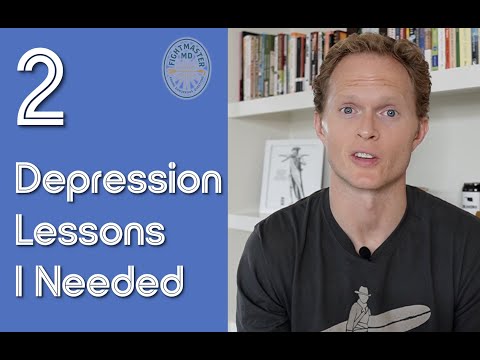
Video unavailable
This video can't be played right now.
How Being Depressed Helped Me Quit Medicine
Yes, depression can serve a purpose. No, I wouldn't do it again. Join my newsletter community: https://fightmastermd.com/newsletter/ (When you sign up, you'll receive my free 7-day course toward jumpstarting your career change!) Get my first book "32 Lessons From 8 Years Lost in Medicine" on Kindle or audiobook: https://a.co/d/jcpPYt7 =Most Watched Videos= 4 Reasons People Go to Med School: https://youtu.be/lePQ_mA2GR4 3 Reasons Why Doctors Are Leaving Medicine: https://youtu.be/y7jLN_wuot8 How My Life Changed After Medicine: https://youtu.be/CUybkeqoY28 From medical student, to psychiatrist, to writer, I've shared lessons from the whole journey on my website: https://fightmastermd.com/ Transcript: Today, I’m break down how two separate depressions I experienced, helped me build a life I love. And along that path, imparted lessons I needed. The first depression occurred during my third year of medical school. Timing-wise, it was somewhat confusing. I’d recently scored in the 90th percentile on Step 1, earned honors in most courses to that point, and had just appeared on the Dr. Oz show. I was tracking to land a residency program of my choice. But I’d lost who I was… because the sacrifice and commitment necessary to make those grades and earn those honors, wasn’t actually worth the cost to me. Midway into third year of medical school, the year notable for 60 hour work weeks and late nights studying, I became depressed and resentful, toward everything. When I went to medical school, not actually wanting to be a doctor but needing the social acceptance of being a doctor, I figured I could forego what I wanted and it would be fine in the end. Third year of medical school was where that assumption began to crack, where it needed to crack. Not quite ready to pull the parachute on medicine, I took steps to own a future I did want, because I did not want to feel that way again. I boldly went after psychiatry residency programs in surf able locales (what I did want at the time), and inside the residency I figured aligned with my values and interests. Slowly, I began to understand something: it is only my responsibility to take care of my happiness. And I can do something about that. The second depression occurred during intern year, where the story was similar: long hours, too much time in the hospital doing things I didn’t want to do, blah blah blah. The difference was the setting: I was now (on the coast) where I figured would solve my happiness problem (while surfing)… and I wasn’t happy, huh. I’d run out of pipedreams, no residency mirages off on the horizon. Just me and a plan built upon a failed assumption: I can do something I don’t want to do and be happy. My plan for what would make me happy had fully manifested and… I was depressed. I also had no idea how to fix it, thus I was forced into another choice: keep pretending I know what I’m doing and repeat the cycle or go get help. By second year of residency, I was in therapy. I surrendered my all-knowing omnipotence. Which, after four more years of repeated lessons and micro-progress, got me here. The pearl of the second depression was more foundational: I am not omnipotent and have limitations. I cannot do things I fundamentally don’t want to and be okay. Over my psychiatry training (and repetitive exposure to treatments for depression), I’ve found myself exploring the paradox of depression treatment, resolution, and the idea of depression “prevention”. If it not for my depressions, say if I were to have been made to “feel better”, would I still be stuck in a life I didn’t want. For me they were insightful departures that I desperately needed. How can I say different? I’m not saying depression shouldn’t be treated, indeed often aggressively it should be, same said for suicidal ideation, and at the same time those episodes can be viewed as an opportunity, which for me was accessible inside of therapy, something I was fortunate enough to have access to. P.S. If you’re going through something and need support, the National Suicide Hotline (dial 988) is a fantastic outreach program for resources. Asking for help has been huge part of my journey. This is not healthcare advice. My video is not intended to provide medical advice, diagnosis or treatment. Please consult with your physician or other healthcare professional regarding any medical or health-related diagnosis or treatment options.) #physicianburnout #physiciandepression #depression #depressiontreatment #doctors #medschool #medicalschool #medschoolproblems #medschoolvlogs Music from Uppbeat (free for Creators!): https://uppbeat.io/t/moire/bees-in-the-garden License code: DOLTT548MXNWXAYC
Suggested videos
Best Advice I Got In Medical School (But Wish I'd Gotten Before)
Ryan Fightmaster, MD · 2:53

What Helped Through Depression
vlogbrothers · 4:14
Everything I've Learned Since Quitting Medicine
Ryan Fightmaster, MD · 7:22

How to Destroy Your Depression
HealthyGamerGG · 26:02

The Real Reason I Quit Medicine... Is Not What You'd Predict
Ryan Fightmaster, MD · 1:30
Understanding & Conquering Depression | Huberman Lab Essentials
Andrew Huberman · 35:41

Why Doctors DON'T Quit Medicine
Ryan Fightmaster, MD · 11:07

Daily Routine To Fight Off Depression
Psych2Go · 10:23
How My Life Changed After I Quit My Job As A Doctor
Ryan Fightmaster, MD · 3:47
Can You Stop Your Bipolar Medication? – Maybe Here’s How
Dr. Tracey Marks · 9:26

3 Reasons Why Doctors Are Quitting Medicine (And The Real Reason)
Ryan Fightmaster, MD · 10:17

Managing depression without medication
Jennie Byrne, MD, PhD · 13:08