

Video unavailable
This video can't be played right now.
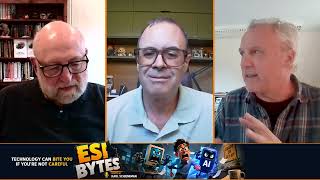
Spooky Scary AI Validation Show
A Halloween special this time around. I sat down with Herb Roitblat and Jeremy Pickens to talk through the ghosts that keep haunting eDiscovery validation, from elusion testing to the hallucinations showing up in generative AI review. Herb built some of the earliest machine learning tools in this space with Dolphin Search and later OrcaTec, the technology our Global Aerospace team used to push TAR forward in court. Jeremy is a well-known data scientist who has worked with Catalyst, Open Text, and Redgrave Data, and he joined this conversation strictly in his personal capacity. This was a really fun conversation between pioneers in data validation in the e-discovery field who have built approaches to validate that come at the problem from different directions. Despite their difference, they have a lot of respect for each other. And their different perspectives made for a really fascinating discussion on data validation in the e-discovery space. Then at the end, Carmela, a frail rescue dog who has outlived the vets' claim that she would pass shortly after we found her, made her Halloween debut 5 months after her supposed date with death, in a costume built for a 75-pound frame, proving data validation could be better used by Halloween Costume manufacturers. Guest Introduction Herb Roitblat is the CTO of Reliath AI, a company building technology to eliminate AI hallucinations. He helped develop early machine learning tools in the legal space with Dolphin Search and later built OrcaTec, the technology behind the Global Aerospace case. Jeremy Pickens is a data scientist and information retrieval researcher who has worked with Catalyst and Redgrave Data, joining this conversation in his personal capacity. Key Takeaways Validation sounds simple in theory, counting what you produced against what you withheld, but gets complicated fast once human disagreement enters the picture, with two independent review teams often splitting on roughly half the documents they look at. Elusion testing can mislead people badly when a collection has very low richness, since producing even one responsive document can make an elusion sample look artificially strong. A classifier trained on contract reviewers who over-mark documents as responsive sometimes outperforms one trained on a senior attorney’s more precise calls, because surprisingly, liberal reviewers create more consistency within a small, imbalanced class of documents. Machine predictions can quietly become the ground truth they’re supposed to be tested against, since once a reviewer sees a machine’s prediction before making their own call, there’s no clean way to separate whether the final judgment came from the person or from the machine’s influence. People defer to AI recommendations more than they realize, with analysts in a recent study siding with a language model’s recommendation the overwhelming majority of the time, even on equally reasonable positions, and often repeating its reasoning as their own. Chapter Markers 00:00 Introduction: a Halloween validation special with Herb Roitblat and Jeremy Pickens 03:07 Is validating a production actually simple 06:39 Explaining CAL, TAR 1.0, and the models behind them 10:03 Elusion testing and how a low richness collection can mislead you 12:18 Herb and Jeremy debate whether pre-coded predictions bias reviewers 19:36 The Global Aerospace case and why best practices shouldn’t declare a single winner 23:17 Carmela’s Halloween costume break 23:43 Bias versus variance: do liberal reviewers actually train better classifiers 36:39 Who certifies the model when AI is doing the training 37:22 The Anthropic study on how often people defer to machine recommendations 44:07 Herb’s story about a senior attorney overturning his own earlier calls 48:37 Karl on building a career around testing document reviewers 50:41 Is contract review variance actually a hidden advantage 55:38 The Department of Health and Human Services hallucination case 58:14 Closing thoughts and Happy Halloween eDiscovery validation, elusion testing, technology-assisted review, CAL, TAR 1.0, generative AI hallucinations, document review bias, anchoring bias AI, contract reviewer consistency, machine learning classifier training, Herb Roitblat, Jeremy Pickens, OrcaTec, Global Aerospace case, legal AI research, ESI Bytes podcast, review certification, precision and recall, eDiscovery podcast
Suggested videos
Retrieving ESI From Cloud Applications
ESIBytes · 28:58
ESIBytes Electronic Discovery Tips From Tess Blair
ESIBytes · 19:00

Meet the New Executive Director of The Sedona Conference Tim Opsitnick and the New ESIBytes 2.0
ESIBytes · 40:15
New Federal Rules eDiscovery Rule 26f Amendments Worth It
ESIBytes · 49:11
Patrick Oot ESIBYTES eDiscovery Podcast
ESIBytes · 34:49
Why Lawyers Need to Defend Critical Thinking in an AI World
ESIBytes · 48:35

Effectively Interviewing Custodians To Find ESI by Sherry Harris
ESIBytes · 29:01

Predictive Coding What's In The Black Box
ESIBytes · 41:44