
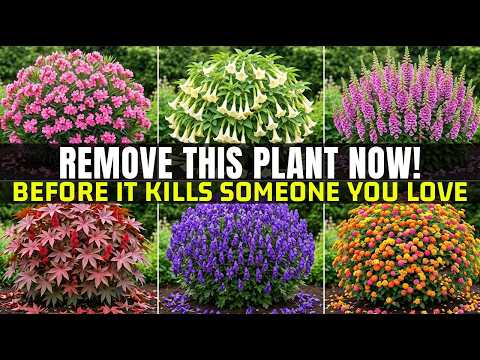
Video unavailable
This video can't be played right now.
13 Deadly Poisonous Plants Hiding In Your Backyard – You Might Already Own One!
13 Dangerous Garden Plants Sold at Every American Nursery (One You'd Never Suspect)** Every April across America, millions of families load their cars at the nursery with plants they've seen a hundred times — bright colors, healthy-looking leaves, price tags that seem perfectly reasonable. Nobody hands them a warning. In the United States, there is no federal requirement for nurseries to label plants as toxic to humans or animals at point of sale. A plant that can send a child to the emergency room can sit right next to the tomato starts with nothing on the tag but a watering schedule. This is not about fear — it's about the knowledge that changes how you shop, how you plant, and what you allow near the people and animals in your home. This video breaks down 13 commonly sold garden plants that are genuinely dangerous, plus one plant near the end that quietly grows in yards from coast to coast and almost nobody identifies as a risk. 🎯 **What You'll Learn** - The 13 dangerous plants sold openly at mainstream garden centers, and exactly what makes each one toxic - Which parts of each plant are dangerous, and to whom — children, pets, or both - The USDA zones and common varieties for each plant so you know if it's already in your yard - Safer, equally beautiful alternatives for every dangerous plant on this list - Three mistakes homeowners make even after they know which plants are dangerous 🌿 **The Full Plant List** 1. Oleander (*Nerium oleander*) – Cardiac glycosides in every part; even burning cuttings releases toxic smoke 2. Foxglove (*Digitalis purpurea*) – Source of digoxin; entire plant toxic, self-seeds prolifically 3. Lantana (*Lantana camara*) – Berries are a leading cause of feline liver toxicity 4. Autumn Crocus (*Colchicum autumnale*) – Blooms with no leaves in fall, leaves appear alone in spring — a dangerous mismatch 5. Angel's Trumpet (*Brugmansia*) – Tropane alkaloids cause hallucination and cardiac effects 6. English Yew (*Taxus baccata*) – Toxic seed hidden inside an attractive, non-toxic red aril 7. Monkshood (*Aconitum napellus*) – Toxic through skin contact alone, not just ingestion 8. Castor Bean (*Ricinus communis*) – Source of ricin; seeds are spiny, eye-catching, and dangerous to children 9. Jimsonweed (*Datura stramonium*) – A volunteer weed with the same toxic alkaloids as Angel's Trumpet 10. Pokeweed (*Phytolacca americana*) – Berries resemble edible wild fruit; roots are especially toxic 11. Water Hemlock (*Cicuta species*) – Considered the most acutely toxic plant native to North America 12. Daphne (*Daphne odora*) – Fastest-onset toxic reaction of any common ornamental shrub 13. Bleeding Heart (*Lamprocapnos spectabilis*) – Beloved shade perennial with neurotoxic alkaloids Full USDA zones, common varieties, price ranges, and the specific mistake most homeowners make with each plant. 🌱 **Safer Alternatives for Every Category** Instead of English Yew hedging → Arborvitae 'Emerald Green' (Zones 3-7). Instead of Lantana → Pentas lanceolata (same heat tolerance, safer profile). Instead of Castor Bean → Canna lily bold foliage varieties (Zones 7-10). Instead of Foxglove → Lupine, Russell hybrid (Zones 4-8). Instead of Monkshood → Tall garden phlox (Zones 4-8). 🌱 **Three Mistakes Homeowners Make Even After Knowing the List** First — assuming removal solves the problem immediately. Pokeweed, autumn crocus, and monkshood leave root or bulb material behind that can regrow the following season. Second — buying a safer category without checking variety-level details, since not all replacement varieties perform the same. Third — not telling everyone else who has contact with the yard what changed and why. 🌟 **Support the Channel** Natural Verge delivers zone-accurate, dollar-grounded, experience-tested plant safety information every single week. Drop your state and one plant from this list in the comments — tell me which one surprised you most. I read every comment. If this video helped you, like and subscribe to Natural Verge. 📌 **Keywords:** toxic garden plants, poisonous plants for pets, dangerous plants for children, oleander toxicity, foxglove poisonous, lantana cat toxic, monkshood danger, castor bean ricin, pokeweed toxic, water hemlock poisonous, safe garden alternatives, pet safe garden plants, garden plant safety, toxic ornamental shrubs #ToxicGardenPlants #PoisonousPlants #PetSafeGarden #DangerousPlants #GardenSafety #OleanderToxicity #FoxglovePoisonous #NaturalVerge #GardenPlantSafety #SafeGardening #garden #gardening
Suggested videos
9 Poisonous Plants That Might Be Lurking in Your Garden
Garden Buildings Direct · 4:20
Plant 17 Perennials in Pots Once and Never Buy Plants Again in Life| The Financial Hack
Natural Verge and 2 more · 36:28
8 Most Toxic Plants Hiding in Your Backyard — Every One Explained
DocToxin · 9:29
🌺 Plant These 16 Perennials Once and Hummingbirds Return to Your Yard Every Single Morning
Natural Verge and 2 more · 41:03
Enter the Deadliest Garden in the World
Great Big Story · 2:25
16 Plants That Quietly Bring Bees and Butterflies Back to a Yard That Lost Them for Years 🌸
Natural Verge and 2 more · 28:23
BEAUTIFUL BUT DEADLY | 13 MOST DANGEROUS PLANTS THAT CAN KILL YOU
History Beyond Maps · 30:17
16 Popular Perennial Seeds You Need to Sow in September or Regret for the Whole Year
Natural Verge · 31:55
25 Poisonous Plants & Flowers You Might Have At Your House | Blissed Zone
Blissed Zone · 11:35
Plant These 14 Perennials Once and Your Garden Will Look Like Heaven Every Single Year
Natural Verge and 2 more · 30:41

13 Deadly Plants You Should NEVER Touch
EarthFlix · 29:59
Tree Month - Verge Transformation - Goderich Street Reserve Verge 1
City of Perth · 1:36