
Video unavailable
This video can't be played right now.
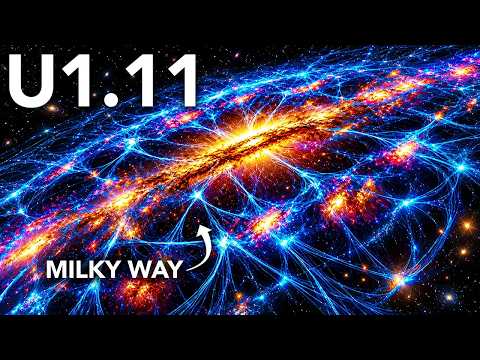
Science For Sleep | U1.11 — The 2.5-Billion-Light-Year Giant
Now on Spotify 🎧 Listen here: https://open.spotify.com/show/033FAXP3qkVJt1VjSLKI60 Far beyond the familiar galaxies of our cosmic neighborhood, astronomers have discovered an extraordinary arrangement of some of the brightest objects in existence. It stretches across a distance so enormous that even light would need billions of years to travel from one end to the other. In this episode, U1.11 — the 2.5-billion-light-year giant becomes a gentle journey into one of the largest proposed structures in the observable universe. Identified in 2011 using data from the Sloan Digital Sky Survey, U1.11 is a remarkable example of a Large Quasar Group, or LQG. It contains 38 quasars, distributed across a region whose longest estimated dimension reaches approximately 2.5 billion light-years. Quasars are extraordinarily luminous galactic centers powered by supermassive black holes consuming surrounding matter. Their brilliant radiation allows astronomers to observe them across immense cosmic distances, making them valuable markers for mapping the universe's hidden structure. But what makes U1.11 so fascinating is not simply its size. It is the possibility that these distant quasars trace an enormous concentration of galaxies and matter within the cosmic web — the intricate network of filaments, clusters, and vast empty regions that stretches throughout the universe. Located in the direction of Leo and Virgo, U1.11 lies near another famous quasar association known as the Clowes–Campusano Large Quasar Group. Its name comes from its approximate redshift of 1.11, a measurement revealing how much the expansion of the universe has stretched its ancient light. And its immense dimensions raise a fascinating cosmological question. According to the cosmological principle, the universe should become broadly uniform when examined on sufficiently large scales. Yet apparent structures spanning billions of light-years invite astronomers to investigate how such enormous patterns emerge. Could U1.11 represent a genuine concentration of matter on an extraordinary scale? Or might its apparent structure partly reflect the statistical methods used to identify groups of distant quasars? Astronomers continue to explore these possibilities. The quasars are not known to form a single gravitationally bound object, and identifying an enormous association does not necessarily mean that our current understanding of cosmology is incorrect. Instead, U1.11 offers a remarkable glimpse into the challenge of mapping a universe whose largest patterns may extend far beyond anything we can easily imagine. Let this gentle exploration of U1.11, the mysterious 2.5-billion-light-year quasar group, settle softly into your thoughts. Breathe slowly. Imagine thirty-eight brilliant quasars scattered across an almost unimaginable distance, each illuminated by matter spiraling toward a supermassive black hole. Between them lie vast stretches of galaxies, darkness, and ancient cosmic history. And rest in the stillness of a universe where even billions of light-years may be only one small part of a much greater pattern. Sources: Clowes et al. (2012) — Two Close Large Quasar Groups: https://doi.org/10.1111/j.1365-2966.2011.19719.x NASA — Hubble Quasars: https://science.nasa.gov/mission/hubble/science/science-behind-the-discoveries/hubble-quasars/ NASA — Large Scale Structures: https://science.nasa.gov/universe/galaxies/large-scale-structures/ Marinello et al. (2016) — Compatibility of Large Quasar Groups with Cosmology: https://doi.org/10.1093/mnras/stw1513 Böhringer et al. (2025) — Discovery of the Quipu Superstructure: https://doi.org/10.1051/0004-6361/202453582
Suggested videos
Science For Sleep | What’s on the Other Side of the Universe?
Science Before Sleep · 3:12:22
Science For Sleep | Where the Milky Way Is Actually Going
Science Before Sleep · 3:39:40
Science For Sleep | W2246−0526 — The Brightest Galaxy in the Universe
Science Before Sleep · 3:16:26

How Can You Release Stress Before Sleep? Sleep Science Facts To Fall Asleep To
Psychology For Sleep · 2:43:45
Science For Sleep | Why Don’t We Understand Spacetime Yet?
Science Before Sleep · 3:15:38
Science For Sleep | We Found the Fastest Thing in the Universe
Science Before Sleep · 3:59:26
Science For Sleep | The Sun Isn't Actually the Center of Our Solar System
Science Before Sleep · 3:15:56

The COZIEST Autumn Story | The Sleepy Science of Leaves | Sleep Story
Get Sleepy · 3:30:00