
Video unavailable
This video may be inappropriate for some users.
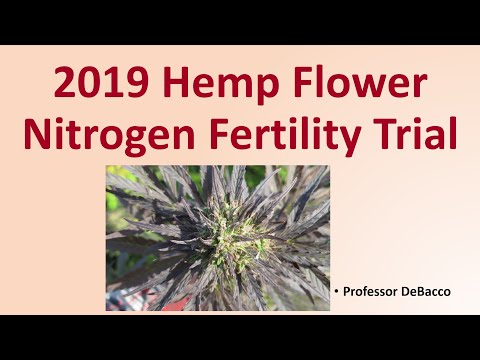
2019 Hemp Flower Nitrogen Fertility Trial
2019 Hemp Flower Nitrogen Fertility Trial Professor DeBacco Reference Article 2019 HEMP FLOWER NITROGEN FERTILITY TRIAL Dr. Heather Darby, University of Vermont Extension University of Vermont evaluated the impact of five different nitrogen (N) application rates on the growth habit, yield, flower quality, and whole plant nutrient concentration of hemp. https://www.uvm.edu/sites/default/files/Northwest-Crops-and-Soils-Program/2019_CBD_Hemp_Fertility_FINAL.pdf How Much Nitrogen? Grows of many crops need to fertilizer each year with nitrogen to help ensure plant growth over the season. Over adding can lead to potential negative environmental impact and(unnecessary) increased cost to the grower. Nitrogen can be variable in the soil so there is the June nitrate test which can help provide an idea of what is in specific fields. However, what is the target for cannabis? How does its response compare to traditional N application rates? Trial Design The trial was initiated at Borderview Research Farm in Alburgh, Vermont and the experimental design was a randomized complete block design with four replications. Plots consisted of five plants spaced 5’ apart in the row and plot treatments consisted of five N application rates listed in pounds of N per acre including… Control (0 lbs) 75 100 125 150 Nitrogen Fertility Rates Plots received nitrogen fertility in split applications over an eight week period starting on 28-Jun in the form of ammonium nitrate plus sulfur (URAN 28-0-0) applied directly to individual plants (Table 3). What About Other Nutrients? Based on soil test results no further nutrients were required for production of hemp. Transplanting and Cover Cropping The 4 week old hemp seedlings were transplanted on 19-Jun into a seed bed prepared with conventional tillage. A cover crop mixture of tillage radish and annual ryegrass was planted between rows on 26-Jun. Irrigation Irrigation was applied on a weekly basis at a rate of 8000 gallons of water per acre delivered via drip tape. Note: Irrigation duration and amount was modified based on weekly rainfall. Pre Harvest From each plot, flower samples were taken from the top 8” of colas and sent to be analyzed for cannabinoid and terpene profiles. Plant Harvest On 21-Oct, all plants were harvested and were broken down *The flower buds were dried at 80⁰ F or ambient temperature with airflow until dry enough for storage without molding. A subsample of flower bud from each plot was dried in a small dehydrator and wet weights and dry weights were recorded in order to calculate the percent moisture of the flower buds. The percent moisture at harvest was used to calculate dry matter yields. After middle three plants were harvested and measurements collected, remaining two plants were harvested on 28-Oct and chipped to be analyzed for whole plant nutrient concentrations. Growing Season Weather July was hot and dry Compared to the 30-year average August and September were slightly cooler than normal October had warmer above average temperature and precipitation. Plant Height and Weight Plant height did not differ significantly between N application rates (Table 5). Whole plant weight was highest when grown at 75 lbs N ac-1, 125, and 150 lbs N ac-1 rate. Flower Bud Yield At harvest a composite subsample of flower material was collected from each plot and dried down This was used to determine flower dry matter and calculate dry matter flower yields There was no significant difference amongst treatments for dry matter yields or yields at 8% moisture. Cannabinoids Terpene Profiles Results from 2019 Trial The 100 lbs N ac-1 rate showed over 1% higher values for CBD compared to the next highest values and results suggested that N rates may have an impact on CBD concentration but not THC concentrations for this T2 cultivar. Despite minor yet not statistically significant differences in yields, flower quality differences in the form of cannabinoids and terpenes were noted with changes in N rates Note that the 100 lb/A rate yielded the highest CBD % weight. While this was not significantly different than the 125 or 150 rates this 75 lb/A rate has the highest levels of terpenes but lowest CBD% Suggestions For Cannabis Production Growers should be using 100 pounds per acre of nitrogen as the target when it comes to cannabis production. This will offer the best chance at a quality yield with reduced chance of negative environmental impacts. Link to Lecture Slides: https://drive.google.com/file/d/10dblE_q5BKtRkC0wXIaHDHMy7dktRsuD/view?usp=sharing *Due to the description character limit the full work cited for "2019 Hemp Flower Nitrogen Fertility Trial" can be viewed at... https://drive.google.com/file/d/1UjlZinz7PXQ2-zo0FSfp1y-CMzO7IZxl/view?usp=sharing
Suggested videos
Symptoms of Hop Latent Viroid (HLVd)
DeBacco University · 6:24

2019 Kansas State University Industrial Hemp CBD Variety Trial
DeBacco University · 15:14
Preparing a Cannabis Plant for Cloning
DeBacco University · 4:00
FIM F I Missed Pruning Method for Cannabis Production
DeBacco University · 4:36
How Vapor Pressure Deficit Impacts Cannabis Plants
DeBacco University · 8:13

Understanding Visual Cues of Cannabis Trichome Development to Maximize Harvest
DeBacco University · 5:57
A Scientific Approach Comparing Growing Substrates for Cannabis
DeBacco University · 21:23

Improving Flower Mass and Metabolites with High Light Intensity
DeBacco University · 14:00

Testing Cannabis Plant Material for Terpenes
DeBacco University · 4:29