
Video unavailable
This video can't be played right now.
ACM CODASPY '20 - CRAPE: A Privacy-Enhanced Crash Reporting System
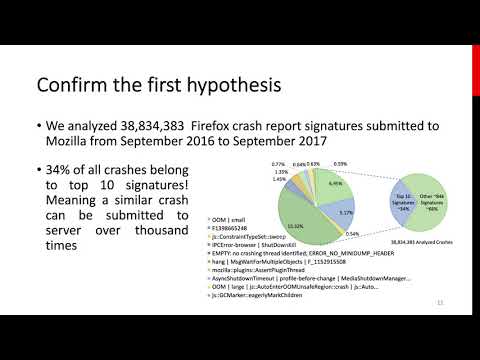
CRAPE: A Privacy-Enhanced Crash Reporting System Kiavash Satvat (University of Illinois at Chicago), Maliheh Shirvanian (Visa Research Lab), Mahshid Hosseini (University of Illinois at Chicago) and Nitesh Saxena (University of Alabama at Birmingham) Software crashes are nearly impossible to avoid. The reported crashes often contain useful information assisting developers in finding the root cause of the crash. However, crash reports may carry sensitive and private information about the users and their systems, which may be used by an attacker who has compromised the crash reporting system to violate the user's privacy and security. Besides, a single bug may trigger loads of identical reports which excessively consumes system resources and overwhelms application developers. In this paper, we introduce CREPE, a security-concerned crash reporting solution, that effectively reduces the number of submitted crash reports to mitigate the security and privacy risk associated with the current implementation of the crash reporting system. Similar to the currently deployed systems, CREPE aggregates and categorizes the crashes based on their root cause. On top of that, the server marks the crash categories in which sufficient reports have been received as "saturated" and informs the clients periodically through software updates. On the client, CREPE engages the reporting application in categorizing each crash to only submit reports belonging to non-saturated categories. We evaluate CREPE using one year of data from Mozilla crash reporting system containing 38,834,383 reports of Firefox crashes. Our analysis suggests that we can significantly reduce the number of submitted reports by bucketing 100 most frequent crash signatures at the client. This helps to preserve the security and the privacy of a significant portion of users whose data has not been shared with the server due to the redundancy of their crash data with previously submitted reports. View the full ACM CODASPY '20 program at http://www.codaspy.org/2020/program.html
Suggested videos

ACM CODASPY '20 - A Hypothesis Testing Approach to Sharing Logs with Confidence
ACM CODASPY · 13:53
Teaser: Hacksaw: Biometric-Free Non-Stop Web Authentication in an Emerging World of Wearables
ACM WiSec · 1:31

ACM CODASPY '20 - Attacking and Protecting Tunneled Traffic of Smart Home Devices
ACM CODASPY · 15:24

EAI SecureComm 2020 - Day 3 | Int. Conference on Security & Privacy in Communication Networks
EAI · 6:08:52

BarrierBypass: Out-of-Sight Clean Voice Command Injection Attacks through Physical Barriers
ACM WiSec · 20:26
CODASPY '22: A Modular and Extensible Framework for Securing TLS
ACM CODASPY · 18:52

EAI SecureComm 2020 - Day 1 | Int. Conference on Security & Privacy in Communication Networks
EAI · 6:44:53

ACM CODASPY '20 - ISAdetect: Usable Automated Detection of CPU Architecture and Endianness for ...
Cybersecurity Group at University of Jyvaskyla · 13:36

AcousticPrint: Acoustic Signature based Open Set Drone Identification
ACM WiSec · 5:02

ACM CODASPY '20 - Efficient Private Disease Susceptibility Testing in Direct-to-Consumer Model
ACM CODASPY · 18:45
IEEE EuroS&P 2021 - Press @$@$ to Login: Strong Wearable Second Factor Authentication via Short Me..
IEEE European Symposium on Security and Privacy · 9:01
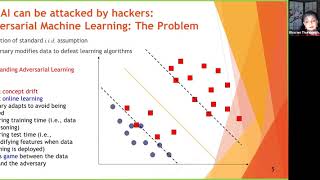
ACM CODASPY '20 Invited Talk - Can AI be Good in the Midst of Cyber Attacks and Privacy Violations?
ACM CODASPY · 33:32