
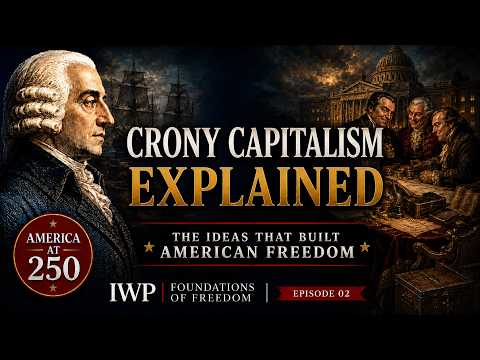
Video unavailable
This video can't be played right now.
Did the Father of Economics Predict Crony Capitalism?
This episode examines the work of Smith (1723–1790), the 18th-century Scottish economist and author of The Wealth of Nations. In Episode 02 of the Foundations of Freedom series, Crony Capitalism Explained, Dr. Anne Bradley sits down with Dr. Samuel Gregg to examine Smith’s critique of mercantilism, crony capitalism, and the political favoritism that distorts free markets. The conversation explores how Smith challenged the belief that national wealth comes from gold, silver, trade manipulation, and government-backed privileges. Instead, Smith saw wealth as the ability of people to satisfy their wants and needs through productive exchange, entrepreneurship, competition, and the rule of law. Dr. Bradley and Dr. Gregg discuss the enduring relevance of The Wealth of Nations, the dangers of zero-sum economic thinking, the rise of modern neo-mercantilism, and the ways crony capitalism corrupts both markets and political life. They also examine Smith’s view that markets depend on equality before the law, why consumers often lose when special interests gain influence, and how appeals to national security can be used to justify subsidies, protectionism, and industrial policy. As America approaches the 250th anniversary of both The Wealth of Nations and the Declaration of Independence, this episode asks why Smith’s economic way of thinking still matters for liberty, prosperity, national security, and the future of the American republic. Speakers: Dr. Anne Rathbone Bradley https://www.iwp.edu/faculty/anne-rathbone-bradley/ Dr. Samuel Gregg https://www.aier.org/people/samuel-gregg/ The Institute of World Politics https://www.iwp.edu/
Suggested videos

The Institute of World Politics: A Graduate School of National Security and International Affairs
The Institute of World Politics · 5:01

IWP: Preparation for a Career in Intelligence and Statecraft
The Institute of World Politics · 1:42
Why The Institute of World Politics? One student’s story
The Institute of World Politics · 3:25
Can America Defend What It No Longer Understands?
The Institute of World Politics · 57:28
Exploring the Foundations of Democracy w/ DR. DENNIS TETI
The Institute of World Politics · 1:10:07
The Intern Experience at The Institute of World Politics
The Institute of World Politics · 1:55
Federal Political Appointments with The Honorable Edmund Moy
The Institute of World Politics · 1:05:44
IWP Student Speaker Series: Terrence Matsuo on Japanese HUMINT
The Institute of World Politics · 48:26