
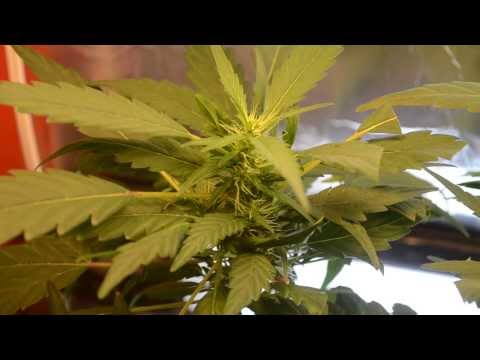
Video unavailable
This video may be inappropriate for some users.
EP. 6 Week 4.5 of flower close up | Indoor CFL Cannabis Grow Cabinet Experiment Closet
Duration: Varies from about 6 to 22 weeks with pure indicas having a shorter flowering time than pure sativas. Mixed indica/sativa strains have an intermediate flowering time. The sex is clearly revealed in the first two weeks of 12/12. Males produce little balls clustered together like grapes. Most plants (except auto flowering strains that flower independently of photoperiod) can flower under diminished light. In nature, cannabis plants sense the forthcoming winter as the Earth revolves around the Sun and daylight reduces in duration (see also season). If females are not pollinated (fertilized by male pollen) they start to produce buds that contain sticky white resin glands or trichomes in a final attempt for pollination by windborne male pollen. The trichomes produce resins containing the largest amounts of THC and CBD, the two main psychoactive substances. Fertilized females produce resinous trichomes but more plant energy is sunk into seeds, which can be half the mass of a fertilized inflorescence; thus, to maximize resin per gram, seedless cultivation is preferred. Buds of the first case are called sinsemilla (it is really two words: "sin semilla," which translates to "without seeds" in Spanish, but is often misspelled as one word). Potent sinsemilla is especially important to medical users, to minimize the amount of cannabis they must consume to be afforded relief. Cannabis with seeds is generally considered to be of inferior quality and/or grown with inferior technique. Indoors, cannabis is induced into flowering by decreasing its photoperiod to at least 10 hours of darkness per day. In order to initiate a flowering response, the number of hours of darkness must exceed a critical point. Generally the more hours of darkness each day, the shorter the overall flowering period but the lower the yield. Conversely, the fewer hours of darkness each day, the longer the overall flowering period and the higher the yield. Traditionally most growers change their plants lighting cycle to 12 hours on and 12 hours off since this works as a happy medium that most strains respond well to. This change in photoperiod mimics the plant's natural outdoor cycle, with up to 18 hours of light per day in the summer and down to less than 12 hours of light in fall and winter.[citation needed] Some 'semi-autoflowering' strains that have been bred exclusively for outdoor use, particularly in outdoor climates such as that of the UK, the plants will start flowering with as much as 16--17 hours of light per day. Usually they can start flowering in July and finish far earlier than other strains, particularly those that haven't been bred as outdoor strains. Because the weather in northern latitudes gets very wet and cold during October when many strains start to finish flowering, these semi-autoflowering strains give an advantage as they are far less likely to suffer from botrytis (grey mold) which is caused by wet weather. Alternatively growers may artificially induce the flowering period during the warmer months by blacking out the plants for 12 hours a day i.e. by covering the plants with black plastic for example, which excludes all light during this period so the plant can flower even during long days. Although the flowering hormone in most plants (including cannabis) is present during all phases of growth, it is inhibited by exposure to light. To induce flowering, the plant must be subject to at least 8 hours of darkness per day; this number is very strain-specific and most growers flower with 12 hours of darkness to be safe. Flowers from certain plants (e.g. cannabis) are called Calyx, and are (with cannabis) the most prized part of the plant. In late flowering the calyx are easily visible to the naked eye. Calyx development begins approximately 1--2 weeks after the photoperiod is reduced. In the first weeks of flowering a plant usually doubles in size and can triple. Calyx development ends around 5 weeks into flowering and is proceeded by a period of Calyx "swelling". During this time the buds greatly increase in weight and size.[5 Duration: Varies from about 6 to 22 weeks with pure indicas having a shorter flowering time than pure sativas. Mixed indica/sativa strains have an intermediate flowering time. The sex is clearly revealed in the first two weeks of 12/12. Males produce little balls clustered together like grapes. Most plants (except auto flowering strains that flower independently of photoperiod) can flower under diminished light. In nature, cannabis plants sense the forthcoming winter as the Earth revolves around the Sun and daylight reduces in duration (see also season). If females are not pollinated (fertilized by male pollen) they start to produce buds that contain sticky white resin glands or trichomes in a final
Suggested videos
6 week of flower update and harvest video...
Da Homie Gnomie · 5:02
Sneak E free plants
TheEmptyNester · 10:02

Dreamy Wildflowers: One Patch of Flowers, 11 Different Lenses
Angi Wallace Creative Photography · 17:46

Lil Sneak - Grow [Official Audio]
ImCensor · 2:28
cfl cannibis flowering week 6
Jesse Centers · 4:40

Yukmouth - Gas: Grow and Sale ft. Keak Da Sneak, Stevie Joe
Yukmouth · 3:08

GROW SEASON 4 (6 weeks flower )
MASTER GROWER " P " · 3:35

Yukmouth ft. Keak Da Sneak, Stevie Joe - GAS (Grow And Sale) [Thizzler.com]
Thizzler On The Roof · 3:12
week 6 week 1 flower
Jusnasty “SlingShot Gang” Battle · 3:19

Strictly Business (ft. Richie Rich, E-40, Keak Da Sneak, B-Legit) [Music Video]
SLAPSTAR! · 3:07
CFL Grow week 6 Flowering
Blac Haze · 3:30
Yukmouth - Gas: Grow and Sale (Audio) ft. Keak Da Sneak & Stevie Joe
Yukmouth · 3:12