
Terence Tao: Math 2.0
In this presentation at Science x AI Summit (UCLA) on October 16, Terence Tao explains why mathematics is moving from Math 1.0 toward Math 2.0, and why that transition depends on new shared infrastructure such as the Open Math Model. Solving problems in pure mathematics suits AI unusually well. Results can be verified objectively, the work is fully digital, and centuries of textbooks and papers provide high-quality data. The result is an era of proof abundance. But more proofs do not automatically bring more understanding. Many recent AI results are hard to follow, good research problems are becoming harder to find, and in applied settings a model can produce an answer that is technically valid but misses the real-world goal. Tao describes two early examples of what comes next. The first is a 22-million-question universal algebra project, formalized in Lean. The second is a competition with the L-functions and Modular Forms Database that took the number of known Galois group examples from about 60 to all 25,000 cases in three months. His Math 2.0 vision calls for experimental mathematics, clearer exposition, shared formal and informal libraries, and AI that strengthens rather than replaces human understanding. Open models, built and governed with the mathematical community, are central to that infrastructure. The Open Math Model is a SAIR initiative led by Terence Tao to give mathematicians open, community-governed AI tools for research. Learn more and apply for access at openmathmodel.org. Outline of this video: 00:00 Why mathematics is moving from Math 1.0 toward Math 2.0 04:04 From proof scarcity to proof abundance 07:05 Looking beyond problem-solving and social-media success stories 10:48 Experimental mathematics and data-driven discovery 13:36 The SAIR-LMFDB polynomial search competition 15:16 Pure and applied math: why understanding matters 18:37 Weather modeling and the risk of solving the wrong problem 21:27 Answers without insight and the search for fruitful problems 24:51 Using AI to strengthen human understanding in Math 2.0 27:32 Open exposition, Mathathons, shared libraries, and reward models
Suggested videos
The AI Era of Science: Insights from John Hennessy
SAIR · 26:20
Terence Tao's Math 2.0: How AI Changes Mathematics
Signal Atlas · 22:51
Sair - Geeta Zaildar (Official Video), New Punjabi Video heartbeat, ranjhe
studio765 · 2:37
Math 2.0: Terence Tao responds to the recent OpenAI flood of proofs
Dr. Samuel Allen Alexander · 38:30
Caltech x SAIR Mathathon: Contestant Guide
SAIR · 4:46
Terence Tao & Yu Deng: Why We Build Open Math Model
SAIR · 22:46
Terence Tao: “You Cannot Trust AI”
Dr Brian Keating · 9:52
Yu Deng: Mathematicians in the time of AI
SAIR · 25:04
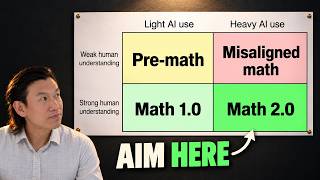
What Terence Tao's Math 2.0 Slides Actually Say About AI and Solving Problems
AI Efficiency Talks · 14:50
Terence Tao & Riley Tao: Turning AI’s Firehose Into Usable Science
SAIR · 20:19

Terence Tao, Get Real!
Unzicker's Real Physics · 7:05
Yu Deng: Fields Medal & Hilbert's 6th Problem
SAIR · 15:54