
IE Irodov Problem 1.76 | Maximum Height of Body | Pulley Constraint & Dynamics | JEE NEET | Physics
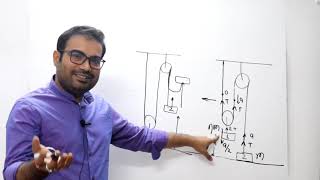
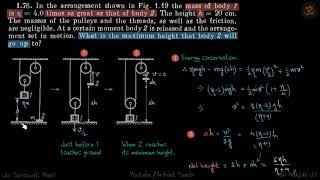
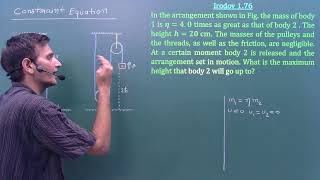
Problem- 1.76: In the arrangement shown in Fig. 1.19, the mass of body 1 is 40 times as great as that of body 2. The initial height is h = 20 cm. The masses of the pulleys and threads, as well as friction, are negligible. At a certain moment, body 2 is released and the arrangement is set in motion. What is the maximum height to which body 2 will rise? In this video, we solve IE Irodov Problem 1.76 from the chapter The Fundamental Equation of Dynamics in Part 1—Physical Fundamentals of Mechanics. The problem involves two bodies connected through an ideal pulley-and-thread arrangement. The mass of body 1 is 40 times the mass of body 2, and the given initial height is h = 20 cm. When body 2 is released, the complete arrangement starts moving. We have to determine the maximum height attained by body 2. Although the question appears to be a standard pulley problem, its solution requires careful analysis of different stages of motion. The pulley constraint must be used correctly to establish the relationship between the accelerations and displacements of the connected bodies. We must also identify the instant at which the nature of the motion changes and then analyse the subsequent upward motion of body 2. In this detailed solution, we discuss: How to interpret the pulley arrangement shown in Fig. 1.19 How to draw the free-body diagrams of both bodies How to apply Newton’s laws of motion How the inextensible-thread condition creates a constraint between the bodies How to find the acceleration of each body How to determine the velocity attained during the connected motion Why the motion may need to be divided into separate stages How to calculate the additional height gained by body 2 How to obtain the total maximum height reached by body 2 Common mistakes in compound-pulley and constraint-motion problems This question is an excellent application of Newton’s laws, connected-body dynamics, pulley constraints and vertical motion under gravity. It teaches us that the maximum height cannot always be found by using a single equation for the entire journey. The motion before and after the change in the system’s condition must be examined separately. The problem is highly useful for students preparing for JEE Main, JEE Advanced, physics Olympiads and other competitive examinations. It develops the ability to convert a complex pulley diagram into clear equations and strengthens conceptual understanding of multi-stage motion. Pause the video after the problem statement and try solving it independently before watching the complete derivation. Regularly practising IE Irodov problems will improve your command over advanced mechanics, constraint relations and unfamiliar numerical problems. Subscribe for more step-by-step solutions from Problems in General Physics by I.E. Irodov and continue unfolding the ideas of physics through conceptual problem-solving. #ieirodov #irodov #irodovsolutions #irodovproblem176 #problem176 #physics #mechanics #dynamics #newtonslaws #lawsofmotion #pulley #pulleysystem #compoundpulley #constraintmotion #connectedbodies #maximumheight #verticalmotion #freebodydiagram #physicsnumericals #class11physics #jee #jeemain #jeeadvanced #iitjee #neet #neetphysics #physicsolympiad #competitiveexams
Suggested videos

IRODOV 1.76 Solution | VNV CLASSES IIT JEE Advanced | Vinay Sir IIT Kanpur Alumni
VNV CLASSES · 3:56

[2024] Google Workspace Beginners Guide | Tips on Getting Started (from an Expert)!
itGenius 🤓 Biz Tech Experts · 11:29
1.76 Irodov Solution Mechanics
IRODOV SCHOOL OF PHYSICS · 9:40

New Google Workspace Update is AMAZING!
Julian Goldie SEO · 8:15

Irodov problem solution 1.76 | English
Con-Learning · 13:36

New Google Workspace Update is ABSURD!
Julian Goldie SEO · 8:03

Newton's Laws Of Motion |Top Selected Problems from Irodov | Q.No1.76 | MB Sir
Kota Pulse by Unacademy · 10:08

How to Use Google Workspace - Complete Tutorial
Howfinity · 10:42
1.76 | Irodov Solutions | Mechanics
Arihant Senior - Ankit Singhvi (IITM) · 3:29

Complete Google Workspace Tutorial - Google Drive, Google Docs, Google Sheets, Google Slides...
Howfinity · 1:52:49
Irodov Solution 1.76 || Mechanics || Olympiad Training || JEE Advance ||
Class Physics · 13:34

Google Workspace Studio (2026): Everything You Need
Tool Finder · 5:40