
I.E.IRODOV PROBLEMS IN GENERAL PHYSICS 1.121
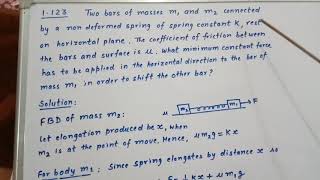
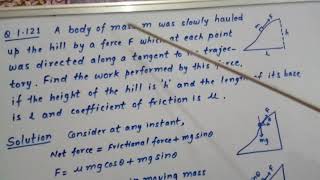
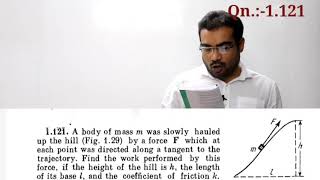
A body of mass m is slowly hauled up the hill by force F which at each point was directer along a tangent to the trajectory. Find the work performed by this force, if the height of hill is h, the length of its base is l , and the coefficient of friction is k. STEPS AND CONCEPT This video provides a detailed, step-by-step physics solution to I.E. Irodov Problem 1.121 (0:40). The problem involves calculating the work performed by an external force required to slowly haul a body of mass up a hill of height and base length given a coefficient of friction (0:50 - 2:55). Key concepts covered in the solution: Slow Motion Principle: The speaker explains that "slowly hauling" the body implies there is no change in kinetic energy, meaning the acceleration is zero and the net force is balanced (5:36 - 6:40). Work-Energy Theorem: To find the external work, the narrator utilizes the work-energy theorem, which states that the sum of work done by conservative forces (gravity), non-conservative forces (friction), and the external force equals the change in kinetic energy (6:55 - 7:20). Work Done by Friction: Because friction is a non-conservative force depending on the path, the narrator performs an integration over the trajectory, using the relation to simplify the expression, ultimately finding the work done by friction to be (8:13 - 11:47). Final Calculation: By summing the work contributions—where the work done by gravity is and friction is —the final result for the external force's work is determined to be (12:08 - 12:42).
Suggested videos

[1.121]- Problems in general Physics by I E Irodov: BEST Solution by AI
Sammvriddhi · 7:56

Don't Lose Marks on These Class 10 Physics Numericals
RAMANUJAN SCHOOL OF STUDIES · 25:38

Score 80/80 in Class 10 Maths: Top Repeated PYQs Solved
RAMANUJAN SCHOOL OF STUDIES · 42:52
Irodov 1.121
IIT SURE · 1:39

RAMANUJAN SCHOOL OF STUDIES
RAMANUJAN SCHOOL OF STUDIES · 9:03
Irodov Problem 1.121
IIT SURE · 1:58
*ALCOHOLS AND ALKYL HALIDES* LECTURE 4 THE SN² MECHANISM
RAMANUJAN SCHOOL OF STUDIES · 36:36
1.121 Irodov solution Mechanics
IRODOV SCHOOL OF PHYSICS · 5:03
*ALCOHOLS AND ALKYL HALIDES* || CLASS 11TH & 12TH
RAMANUJAN SCHOOL OF STUDIES · 32:10

I E Irodov I Physics IWork and Energy I Irodov Problem-1.121 (continued)
Prof. Prakash (BTech IITK) · 6:03

Score 30/30 in Class 10 Biology: Top Repeated PYQs Solved PART 2
RAMANUJAN SCHOOL OF STUDIES · 35:57

I.E.Irodov 1.121 I Work and Energy-Problem
Prof. Prakash (BTech IITK) · 10:01