
FMER Research Webinar: What Happened to Evidence-Based Medicine?
What Happened to Evidence-Based Medicine? Concerning trends in family medicine faculty and resident skills Keynote Speaker Kate Rowland, MD, MS, is an associate professor and the vice chair for education in the Department of Family and Preventive Medicine at Rush University. Dr. Rowland is a graduate of the University of Notre Dame and Rush Medical College. She completed training at the Advocate Illinois Masonic Family Medicine residency and the University of Chicago primary care clinical scholars fellowship, where she received her Master of Science in health studies. She has held leadership positions in student, resident, fellow, and faculty training. She is an associate medical editor for the American Academy of Family Physician’s FP Essentials series and for Essential Evidence. Dr. Rowland co-chairs the Evidence-Based Medicine collaborative of the Society of Teachers of Family Medicine and is a knowledge assessment consultant for the American Board of Family Medicine, as well as a contributor to the ABFM’s National Journal Club. Dr. Rowland also currently serves as the chair of the board of the Illinois Academy of Family Physicians. Her areas of interest include longitudinal medical education, the translation of medical evidence to practice, and the future of evidence-based family medicine. She and her husband, a physics professor, have three children. Summary The Golden Era of Evidence-Based Medicine (EBM) led to multiple philosophies of evidence appraisal and practices for the dissemination of useful evidence. EBM was widely taught and assessed in family medicine residencies. However, over time, EBM transitioned from a skill to an implicit assumption: of course medicine is evidence-based, so there was less need to teach it. A national EBM teaching collaborative noted that more than 50% of members held senior rank or titles, suggesting increasing age of members not reflective of the overall membership. Our 2023 study sought to describe program director assessment of graduating resident skills, as well as to describe faculty availability to teach needed EBM skills. This built on previous work seeking to describe program culture and faculty development needs. EBM is at risk of being lost as a skill if serious attention is not paid to faculty development alongside resident development.
Suggested videos
FMER Research Webinar: International Primary Care Training: Lessons from the McGill-Tongji Program
Family Medicine Education Research Group · 50:26
FMER Webinar: Navigating AI in Medical Education: Considerations for Family Medicine Educators
Family Medicine Education Research Group · 1:08:17
FMER Advanced Research Webinar: Methodological Potentials and Advantages of Mixed Methods Research
Family Medicine Education Research Group · 1:01:02
FMER Research Webinar: Gaps in Our Knowledge That Should be the Focus for Medical Education Research
Family Medicine Education Research Group · 1:00:11
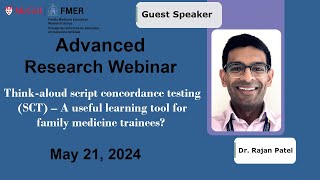
FMER Research Webinar: Think-aloud script concordance testing for family medicine trainees
Family Medicine Education Research Group · 1:02:45

FMER Research Webinar: Strengthening Family Doctors' Response to the Abuse of Older People
Family Medicine Education Research Group · 1:03:48
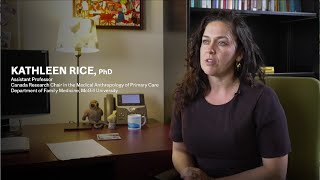
Kathleen Rice: Canada Research Chair in the Medical Anthropology of Primary Care
Family Medicine Education Research Group · 5:24
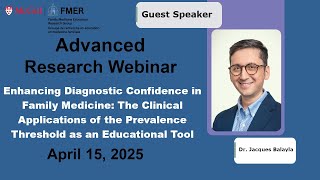
FMER Research Webinar: The Clinical Applications of the Prevalence Threshold as an Educational Tool
Family Medicine Education Research Group · 1:00:45