
Rethink your Impurity Analysis Strategy
In this webinar, Dr. Ejvind Mørtz discusses the benefits and applications of mass spectrometry (MS)-based host cell protein (HCP) analysis and why HCP ELISAs are insufficient for documenting product-related impurities. Watch to learn where to apply the assay in a typical process and what you gain from deploying it to your workflow. A critical challenge in the development and manufacture of biologics is the profiling of process-related impurities. Traditionally, ELISAs have been the go-to analytical method, as they are available off the shelf and are quick to use. However, a generic E. coli or HEK ELISA kit might not be specific and sensitive enough to match the drug product. It may therefore underestimate the HCP levels in the drug substance samples, resulting in a risk of delays if a process-specific assay shows higher levels later on. In other cases, it is impossible to find a suitable generic ELISA – e.g., when using Sf9, Vero, or A549 expression systems. In this case, you may be looking into developing a process-specific assay for analyzing impurities and evaluating your purification process’ ability to reduce HCPs. A process-specific ELISA is time-consuming to develop due to the immunization of an appropriate animal host or several hosts with the HCPs. Moreover, it is inflexible, meaning that if you change any purification step, you might have to develop a new set of process-specific HCP antibodies. As an alternative, some companies use mass spectrometry as an orthogonal method – but up til now had to stick with insufficient ELISAs for release testing. However, now there is an alternative: Based on more than eight years of research and optimization, as well as 300+ customer projects, the Alphalyse team offers a unique HCP analysis method – which works well for all types of biologics and expression systems. The method is based on mass spectrometry (MS) and has the unique capability of detecting and quantifying individual HCPs specific to any product – even in rare cell lines. Since it identifies and quantifies all proteins in a sample, you can even use it to track process-related residuals and viral proteins. In 2021, Actinobac Biomed Inc was the first company to include mass spectrometry data from Alphalyse for IND documentation of host cell proteins – which the FDA approved without requesting HCP-ELISA data. Furthermore, Alphalyse is now the first laboratory to successfully validate an MS-based HCP analysis method to GMP level for use on all cell lines. Thus, you can use it throughout your process and as a release assay as part of your BLA. Key Topics Include: - Learn how an MS-based assay solves the problem of finding an HCP assay with sufficient coverage - Get examples of how detailed knowledge about individual HCP characteristics, like pI and Mw, empowers you to remove specific HCPs intelligently - Get a good understanding of how to efficiently monitor HCPs throughout all process steps – using reproducible, comprehensive data To learn more, go to: https://insidescientific.com/webinar/rethink-your-impurity-analysis-strategy/
Suggested videos
Applications of Human Intestinal Organoid Cultures in Drug Discovery
InsideScientific · 1:00:51
Presentation at Exelixis Pharma. “Nitrosamine Challenges in Drug Development: Are You Prepared?”
Emery Pharma · 1:48

Cellular Brain Repair for Parkinson’s Disease: Is the Answer in the (Biomaterial) Matrix?
InsideScientific · 59:28
NextGen Biomed | Innovative Peptide Manufacturing Methods That Scale
CPC Scientific Inc. · 17:20
Synthetic Peptide Growth Factors: Forging the Path Forward for Regenerative Medicine & Cell Therapy
InsideScientific · 44:20
Overcoming Challenges for the ASTM List of Elements in Cannabis and Hemp Flower
PerkinElmer · 26:58
A Human iPSC Line and Neural Progenitor Cells for Downstream Differentiation Applications
InsideScientific · 54:36
Nitrosamine Uncovered Episode 3
USP · 17:27
What’s Next in Preclinical Cancer Immunotherapy Research?
InsideScientific · 35:01
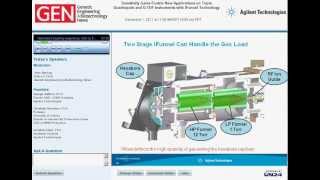
New Applications on Triple Quadrupole and Q-TOF Instruments with iFunnel Technology
GENNews · 1:11:46
Industry Interview – Talking Neuroscience with Leonard Khiroug
InsideScientific · 9:51

JEE & NEET 2021 Chemistry | Solid State (L-06) part-1 | Defects in Solids | With- RK ROY (ISC,BHU)
Advait Vidyaniketan · 1:14:45