
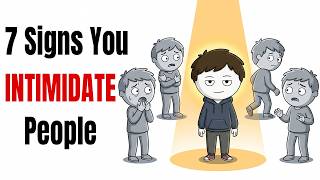
7 Signs You Intimidate People (Without Realizing It)
Have you ever noticed that people become more careful, quieter, or slightly distant around you — even when you’re not doing anything wrong? In this video, we explore the psychology behind why some people unintentionally intimidate others. The psychology of intimidation is often subtle, and it is not about dominance or aggression. It often comes from calmness, emotional control, and self-awareness. When someone shows emotional stability, strong boundaries, and low need for validation, it can quietly shift the dynamics in a room. That’s why traits like silence, emotional neutrality, direct communication, and independence can sometimes trigger discomfort in others. You’ll discover how the psychology of intimidation works through everyday behaviors — from how you handle silence, avoid drama, speak directly, stay rational during conflict, and set firm boundaries. Most importantly, you’ll understand why the psychology of intimidation is often misunderstood as “coldness” or “arrogance,” when in reality it can simply be self-possession. 🌱 Support Apex: https://ko-fi.com/apexpsychology 🚀 Become an Apex member: https://www.youtube.com/@ApexPsychologyYT/join 👇 Comment below: Which sign do you relate to the most — and have people ever misunderstood you because of it? 📚 References: • Evolutionary Psychology: Group bonding, social signaling, and threat perception in silence • Neuroscience: Amygdala response to uncertainty and social ambiguity • Cognitive Psychology: Theory of mind and social prediction errors in interpersonal perception • Behavioral Psychology: Boundaries, assertiveness, and refusal behavior (saying “no”) • Social Psychology: Social comparison theory and group conformity pressure • Jungian Psychology: Individuation process and development of psychological independence • Nonverbal Communication Studies: Micro-expressions, gaze perception, and social signaling ⚠️ Disclaimer: This video is for educational and informational purposes only. It is not intended to diagnose, treat, or replace professional psychological or medical advice. #intimidating #psychology #personality
Suggested videos
Psychology of Rest: Recover So Well It Makes You Dangerous
Apex Psychology · 16:13
7 Signs You Intimidate People (Without Realizing)
Psychology Simplified · 8:12
The Psychology of People Who Talk to Themselves
Apex Psychology · 18:49

7 Signs People are Intimidated by You (Here's Why)
Mind Decoded · 6:31
What If You Stopped Sleeping (The Strange Psychology Behind It)
Apex Psychology · 15:44
7 Signs You Intimidate People (Without Realizing It)
Quiet Mind and Psychology Decoded · 10:01

The Depressing Psychology of Deep Thinkers
Apex Psychology · 16:11
7 Signs You Intimidate People Without Knowing It
Lockedinangelo · 3:51
You're Too Self-Aware to Be Happy | The Psychology of Overthinkers
Apex Psychology · 16:27

7 Signs You Intimidate People (Without Even Trying)
Psychology Inside US and Peak Psychology · 10:07
Psychology of People Who Have No Friends
Apex Psychology · 13:42
7 Signs You Intimidate People (Without Knowing it)
Psychology Layers · 10:49