
Below the Fish Limit: Why No Fish Has Ever Been Found Below 8,400 Metres
In 2022, a baited camera in the Izu-Ogasawara Trench filmed a young snailfish at 8,336 metres — the deepest fish ever filmed. It was not supposed to be much deeper than that. Nine years earlier, scientists had drawn a line across the deepest ocean on Earth: a depth no fish, by their calculation, could ever cross. This film follows that line — the molecule behind it (TMAO), the record fish that tested it, the cameras that found nothing deeper, and the 2025 genetics paper that challenged the whole idea. Below the line, the ocean is not empty. It is simply fishless — and it belongs to amphipods, sea cucumbers and single-celled giants. Chapters: 0:00 The Deepest Fish Ever Filmed 1:11 Where Fish Stop 3:01 The Snailfish Family 4:07 TMAO: The Molecule and the Line 5:54 Testing the Prediction 8:00 The Challenge From the Genome 10:11 Life Below the Fish Limit 12:09 A Line the Ocean Can Break Sources: • Yancey, P.H. et al. (2014). "Marine fish may be biochemically constrained from inhabiting the deepest ocean depths." PNAS 111(12): 4461–4465. DOI: 10.1073/pnas.1322003111 • Xu, H. et al. (2025). "Evolution and genetic adaptation of fishes to the deep sea." Cell 188(5): 1393–1408. DOI: 10.1016/j.cell.2025.01.002 • Jamieson, A.J. et al. (2023). Deepest fish record, Izu-Ogasawara Trench. Deep-Sea Research Part I 199: 104132. DOI: 10.1016/j.dsr.2023.104132 • Linley, T.D. et al. (2016). "Fishes of the hadal zone." Deep-Sea Research Part I 114: 99–110. DOI: 10.1016/j.dsr.2016.05.003 • Gerringer, M.E. et al. (2017). Mariana snailfish (Pseudoliparis swirei) description. Zootaxa. • University of Western Australia news release, 3 April 2023 — deepest fish filmed (8,336 m) and caught (8,022 m). • Journal of Experimental Biology (2024) 227: jeb246522 — deepest swim-bladder fish (Coryphaenoides yaquinae, 7,259 m). How this film was made: all visuals are AI-generated illustrations in our house style — they are illustrations, not real footage. The small "REAL" insets are AI-generated photo-style images of the real animals and vessel, included to show true appearance; they are not expedition photographs. The real 8,336 m footage belongs to the expedition — see the University of Western Australia release above. Ambient sound is synthesised scene sound, mixed at half the narration level; there is no music. Where the science is unsettled, the film says so on screen: FACT, THEORY and CHALLENGED labels mark what is measured, what is predicted, and what is still being argued about. INTO THE DEEP. BEYOND THE KNOWN.
Suggested videos

Film Theory: The Scary Monsters Living Under Your Feet! (The Descent)
The Film Theorists · 13:56
Why No Fish Lives Below 8,400 Metres
Abyss Report: Into the Dark · 23:01

The Descent Uncut: How The UK Ending Reframes The Crawlers
Lou's Dark Side · 8:50
A Quarter of the Ocean Has No Fish
Signal Floor · 11:45

The Descent (2005) Explored
FilmComicsExplained · 11:39
Why No Fish Can Survive Below 8,400 Meters: The Deepest Living Fish in the Mariana Trench
Below 1000 Meters · 12:10

The Descent Begins: Blackout Files Raw Official Trailer
Blackout Files Raw · 1:39
Why Fish Disappear Below 8,400 Meters | The Deepest Snailfish Ever Filmed
MINUTEVERSE · 17:09

Revisiting Kowalski Part Two: The Descent | Nobody Should Believe Me | Case Files
Nobody Should Believe Me · 29:16
Below 8,400 meters no fish survives: the limit of the Mariana Trench
Renderium · 21:20

The Descent, Pt. 2
David Julyan · 4:04
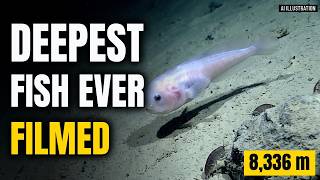
Below This Depth, No Fish Has Ever Been Seen. The Trench Keeps Going.
DEEP DESCENT · 10:22