
Video unavailable
This video can't be played right now.
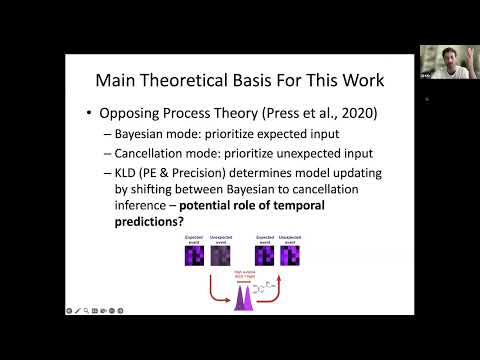
How do temporal and content-based predictions shape visual processing? - Gil Kfir
This study aimed to investigate how content-based (“what”) and temporal (“when”) predictions interact to shape visual perception within a predictive processing framework. Using MEG data from 30 participants viewing sequences of rotating Gabor patches, the study applied an inverted encoding model (IEM) to decode orientation signals and compare neural responses across conditions varying in temporal and orientation congruency. Contrary to the hypotheses, no significant interaction or simple effects of temporal prediction were found, suggesting limited evidence for combined predictive influences under the current design. The findings highlight potential methodological constraints, including limited statistical power, and raise questions about how temporal precision and motor-related processes might be more effectively examined in future research. Gilad Kfir is a neuroscientist and organizational consultant in practice. In his research work he is currently affiliated with Universite Paris Cite where he studies the effects of psychedelic experiences on therapeutic outcomes throughout insights and belief updating processes. Monday, March 2, 2026
Suggested videos

In the Theater of Dreams - Adam Safron & Zahra Sheikhbahaee
Theoretical Neurobiology Group · 2:09:24

Quantitative Promise Theory: Intentionality and Inference in Autonomous Agents - Mark Burgess
Theoretical Neurobiology Group · 1:49:41

#62 Karl Friston - The Nature of Everything
The Complexity Lounge · 2:15:50
Category Theory for Neuroscience (pure math to combat scientific stagnation)
Astonishing Hypothesis · 32:16
StarTalk Live Podcast: Big Brains at BAM with Neil deGrasse Tyson
StarTalk · 2:06:56
Dr. Thomas Parr - The Free Energy Principle
The Brain Surgeon's Take · 31:50

The Quantum Theory That Says Your Brain Creates Reality
Aperture · 42:03

Neurobiology Subgrouping
Systems-Centered · 1:29:32