
TerraForming Mars - New Earth pt ☢ Mars marries Vesta 4 + quenched & mooned by Ceres 009
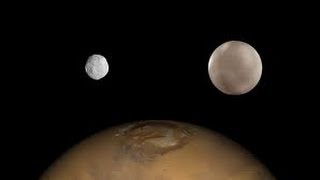
TerraForming Mars - New Earth pt ☢ Mars marries Vesta 4 + quenched & mooned by Ceres ~ Vesta, minor-planet designation 4 Vesta, is one of the largest asteroids in the Solar System, with a mean diameter of 525 kilometres (326 mi) It was discovered by Heinrich Wilhelm Olbers on 29 March 1807, and is named after Vesta, the virgin goddess of home and hearth from Roman mythology. Vesta is the second-most-massive asteroid after the dwarf planet Ceres, and comprises an estimated 9% of the mass of the asteroid belt. The less-massive Pallas is slightly larger, making Vesta third in volume. Vesta is the last remaining rocky protoplanet (with a differentiated interior) of the kind that formed the terrestrial planets. It lost some 1% of its mass less than a billion years ago in a collision that left an enormous crater occupying much of its southern hemisphere. Debris from this event has fallen to Earth as howardite--eucrite--diogenite (HED) meteorites, a rich source of information about Vesta. Vesta is the brightest asteroid visible from Earth. Its maximum distance from the Sun is slightly farther than the minimum distance of Ceres from the Sun, though its orbit lies entirely within that of Ceres. http://en.wikipedia.org/wiki/4_Vesta + Ceres: Ceres, minor-planet designation 1 Ceres, is the largest asteroid and the only dwarf planet in the inner Solar System. It is a rock--ice body 950 km (590 mi) in diameter withCeres's oblateness is inconsistent with an undifferentiated body, which indicates that it consists of a rocky core overlain with an icy mantle. This 100 km-thick mantle (23%--28% of Ceres by mass; 50% by volume) contains 200 million cubic kilometers of water, which is more than the amount of fresh water on the Earth. This result is supported by the observations made by the Keck telescope in 2002 and by evolutionary modeling and the smallest identified dwarf planet. It contains about one-third of the mass of the asteroid belt. Discovered on 1 January 1801 by Giuseppe Piazzi, it was the first asteroid to be identified, though it was classified as a planet at the time. It is named after Ceres, the Roman goddess of growing plants, the harvest, and motherly love. The Cererian surface is probably a mixture of water ice and various hydrated minerals such as carbonates and clays. It appears to be differentiated into a rocky core and icy mantle and may harbor an ocean of liquid water under its surface From Earth, the apparent magnitude of Ceres ranges from 6.7 to 9.3, and hence even at its brightest it is still too dim to be seen with the naked eye except under extremely dark skies. The unmanned Dawn spacecraft, launched on 27 September 2007 by NASA, is expected to be the first to explore Ceres after its scheduled arrival there in 2015. After having orbited asteroid 4 Vesta since July 2011, the spacecraft departed about 5 September 2012. http://en.wikipedia.org/wiki/Ceres_(dwarf_planet)
Suggested videos

FuckYouTube Bait
docatomics · 0:02
docatomics: bringing New Jerusalem to Mars, New Earth TerraFormed pt ☢ Valles Marineris
docatomics · 12:32
☢☢ DocAtomic's boring story ☢☢
docatomics · 17:53
###CME INCOMING ALERT### for June 24 2011
docatomics · 11:01

greenhousing Covert Uranium Basin
docatomics · 4:04
###Solar Storm Warning#CME Impact Advisory### July 12-12 X1.4 Sunspot 1520 001.MTS
docatomics · 4:09
More Grocery Shopping for NO GMO 003
docatomics · 0:39
White Lake Basin, Twin Peaks, Dommion Radio Astronomy Observatory South end, July 6-2011 003.MTS
docatomics · 4:53