
AI-Powered Cyberattacks Explained | AP Cybersecurity 1.4
Artificial intelligence can help people work faster—but adversaries can also use AI-powered tools to make cyberattacks more convincing, scalable, personalized, and difficult to detect. In this AP Cybersecurity lesson, we explore Topic 1.4: AI-Based Cybersecurity Attacks. You’ll learn how attackers can use AI for impersonation, reconnaissance, malicious content creation, vulnerability discovery, social engineering, and other cyber threats. You’ll also learn practical security controls that can reduce the risks created by AI-augmented attacks. 📘 In this lesson, you will learn: • What an AI-augmented cyberattack is • How AI can improve the speed and scale of an attack • How deepfake images, videos, and cloned voices can support impersonation • How attackers use public information to research targets • How AI can generate convincing phishing messages • How AI-enhanced coding tools may be misused • How adversaries may search large codebases for vulnerabilities • How false online information can influence AI systems • Why sensitive information should not be entered into untrusted AI tools • How MFA and identity-verification phrases reduce impersonation risk • Why AI-generated information must be independently verified 🤖 How can adversaries use AI? AI-powered tools can help attackers produce realistic messages, images, audio, and videos. An attacker could imitate a trusted person, create a convincing emergency request, personalize phishing content, or gather information from public websites and social media. Attackers may also use AI-assisted coding tools to modify malicious software, analyze applications, or identify potential weaknesses. This does not make every AI tool dangerous—the risk depends on how the technology is used. 🎭 Deepfakes and voice cloning Deepfake technology can create realistic-looking media using existing images, video recordings, or voice samples. A victim may receive a call that appears to use the voice of a relative, manager, teacher, or public official. Instead of immediately trusting the voice or image, verify the request through a separate communication channel. 🛡️ How to protect against AI-based cyberattacks: ✅ Enable multifactor authentication on important accounts ✅ Create a private verification phrase with trusted people ✅ Confirm unusual requests through a separate channel ✅ Never approve unexpected authentication requests ✅ Limit personal information posted publicly ✅ Avoid entering confidential information into untrusted AI tools ✅ Inspect links, domains, senders, and attachments carefully ✅ Verify AI-generated claims using reliable non-AI sources ✅ Keep operating systems and applications updated ✅ Report suspicious impersonation or account activity 🔐 Use a verification phrase Families, teams, and trusted contacts can establish a private word or phrase for high-risk situations. When a caller requests money, credentials, confidential files, or urgent action, ask for the agreed verification phrase. Do not include the phrase in public messages, social-media posts, or AI prompts. ⚠️ Protect sensitive information when using AI Do not enter passwords, authentication codes, private company data, personal records, financial information, or confidential documents into an AI service unless its data-handling policies and organizational use have been approved. Information entered into online services may be stored, processed, reviewed, or used differently depending on the service. 🎓 Learning objective By the end of this lesson, you should be able to explain how AI-powered tools can augment cyberattacks and recommend controls that protect individuals, accounts, applications, and sensitive information. 📚 About RevisionTown RevisionTown provides clear, student-friendly AP Cybersecurity lessons, practical examples, digital-safety guidance, and exam-focused revision resources. Subscribe for the complete AP Cybersecurity course, including unit-by-unit lessons, cybersecurity scenarios, defensive strategies, and exam preparation. 💬 Question for the comments: You receive an urgent voice message that sounds exactly like someone you trust and asks for confidential information. What should you do before responding? ⚠️ Educational Notice This video is intended strictly for education, cybersecurity awareness, and defensive learning. It does not encourage malware creation, impersonation, unauthorized access, data theft, or misuse of AI-powered tools. AP and Advanced Placement are trademarks of the College Board. RevisionTown is not affiliated with or endorsed by the College Board. #APCybersecurity #AICybersecurity #Cybersecurity #AICyberattacks #Deepfake #VoiceCloning #ArtificialIntelligence #CybersecurityEducation #OnlineSafety #RevisionTown
Suggested videos
AI ATTACKS! How Hackers Weaponize Artificial Intelligence
IBM Technology · 18:36

DNA Explained: Life's Hidden Code | Structure, Replication & Protein Synthesis
RevisionTown · 5:53

What is Cyber Security? Cyber Security threats in 2025 AI Powered cyberattacks & Prompt Injection
M.A.Z lifestyle · 10:19

Mitosis Explained Visually: From Prophase to Two Daughter Cells
RevisionTown · 4:31
AI-Powered Cyberattacks & Social Engineering. How to Detect and Defend Against Them.
Cybercrime Magazine · 2:42

Ionic vs Covalent Bonds Explained: Electrons, Polarity & Crystal Structure
RevisionTown · 7:02

Meiosis Explained: Two Divisions, Haploid Cells & Genetic Variation
RevisionTown · 5:11
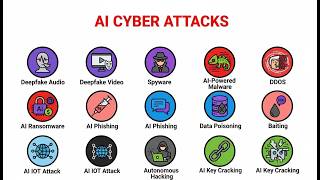
Every AI-Powered Cyber Attack & How They Work Explained
The Cyber Professor · 12:51

Osmosis and Tonicity Explained: Hypotonic, Hypertonic & Isotonic Solutions
RevisionTown · 5:30
🔍 AI-Powered Cyber Threats Explained: What to Expect in 2025! ⚠️
SecureStart AU · 3:47

pH Explained: The Logarithmic Scale, Hydrogen Ions & Buffers
RevisionTown · 4:52
AI-Powered Cyber Attacks: The Next Frontier in Offensive Security
The CISO Perspective · 11:25