
The Mantis Shrimp Has 12 Colour Receptors And Worse Colour Vision Than You
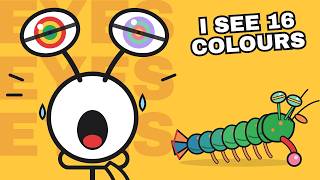
Its punch hits you twice. And it is about ten times worse at telling colours apart than a goldfish. MORE FROM LIFESPAN ▶ The Zombie Ant Fungus Never Touches The Brain: https://youtu.be/ASQi0YJ1oCs ▶ The Tardigrade Survived Space, And Is Not Immortal: https://youtu.be/p9sezoUevKM Welcome back to LIFESPAN. One host, one guest, wildly different lifespans. Your host is INK, an octopus with three hearts and about nine months left. This week's guest is KNUCKLE, a peacock mantis shrimp: ten centimetres long, permanently loaded, and roughly one third of INK's length - which does not slow him down for a second. THREE THINGS IN THIS EPISODE THAT SHOULD NOT BE TRUE, AND ALL THREE ARE 1. One swing, two impacts. The raptorial club accelerates at over 10,000 G and leaves at roughly 23 metres per second - acceleration in the region of a .22 calibre bullet, from a limb smaller than your fingernail. It moves so fast that the water cannot fill the space behind it, so a cavitation bubble tears open and then collapses with a crack. The strike is the first hit. The collapsing bubble is the second. Dodge the club and the water still gets you. 2. Twelve colour receptors. You have three. KNUCKLE's eyes carry up to twelve photoreceptor types spanning deep ultraviolet to far red, sit on independently swivelling stalks, and can detect circularly polarised light - which no other animal has been shown to do. 3. And it is bad at colour. This is the part nobody expects. A 2014 study in Science tested mantis shrimp on telling similar wavelengths apart and found they were around ten times WORSE at it than goldfish, butterflies, birds and humans. Twelve receptors, poor discrimination. WHY, WHICH IS THE GOOD BIT Because it is not doing what your eyes do. You compare - you hold two colours side by side and compute the difference, which is slow and needs a lot of brain. The mantis shrimp scans, and each receptor reports yes or no. It is recognition rather than discrimination: less precise, far faster, and no thinking required. Not a painter's eye. A barcode scanner. For a predator that has to identify a specific colour of prey and commit instantly, that is the better trade. FAIR BALANCE: the punch figures come from laboratory measurements of peak strike performance and vary by species, individual and conditions. Sources differ on whether the count is 12 or 16 photoreceptor types; the 2014 Science paper this episode leans on works with 12, so that is the number used. "Ten times worse" refers specifically to discriminating between similar wavelengths, not to vision overall - its polarisation vision is genuinely without a known equal. CHAPTERS 0:00 Previously 0:35 How big are you actually 0:47 Three things that should not be true 1:50 Name that colour 3:02 Would you survive me 3:40 Last words 4:23 Next week SOURCES Thoen et al., A Different Form of Color Vision in Mantis Shrimp, Science 2014: https://www.science.org/doi/abs/10.1126/science.1245824 Nature news, mantis shrimp's super colour vision debunked: https://www.nature.com/articles/nature.2014.14578 Johns Hopkins News-Letter on the discrimination result: https://www.jhunewsletter.com/article/2015/12/mantis-shrimp-myth-about-vision-debunked/ University of Bristol research record, a different form of colour vision in mantis shrimp: https://research-information.bris.ac.uk/en/publications/a-different-form-of-color-vision-in-mantis-shrimp/ Every fact in every episode is checked against a source before it is written, and the sources are listed here. If something is wrong, tell me in the comments and I will say so in the next episode. Everything on screen is drawn from scratch, and the guest is drawn at its real size relative to INK. The gloves are a joke. The eye stalks are not. NEXT WEEK: something that gets into an insect, walks it to an exact height, locks its jaws, and never once touches its brain. This show uses synthetic voices and original illustration. It is comedy built on real biology. #LIFESPAN #mantisshrimp #octopus #biology #naturefacts #animals #science #vision
Suggested videos

Younger Skin with Peptides? | Lifespan with Dr. David Sinclair - S2, Ep. 11
David Sinclair · 56:03
12 Color Receptors, Worse Color Vision Than You: The Mantis Shrimp Puzzle
Deep Curiosity · 3:27

How to Exercise to Live Longer | Lifespan with Dr. David Sinclair - S2, Ep. 5
David Sinclair · 1:09:14
This Shrimp Has 12 Color Receptors. It Failed a Color Test You'd Pass.
Curious Lab Coat · 8:14

Take This Peptide & Build Muscle? | Lifespan with Dr. David Sinclair - S2, Ep. 12
David Sinclair · 51:38
This Shrimp Has 12 Color Receptors. So Why Does It See Worse Than You?
Oddball Earth · 13:03

Fasting as a Path to Longevity: The Facts | Lifespan with Dr. David Sinclair - S2, Ep. 2
David Sinclair · 1:15:23
This Animal Has 12 Colour Receptors. It Sees Colour Worse Than You
Oddly Interesting · 5:22

This Sugar Substitute May Extend Your Life | Lifespan with Dr. David Sinclair - S2, Ep. 9
David Sinclair · 49:03

Why a Mantis Shrimp Fails a Colour Test
Into The Wildlife · 9:18

Are You Exercising Hard Enough For Longevity? | Lifespan with Dr. David Sinclair - S2, Ep. 6
David Sinclair · 1:11:15
What If You Had Mantis Shrimp Eyes?
Tiny World Tales · 6:33