
What a Kilonova Really Is… And Why It's the Only Event Violent Enough to Create Gold
Almost all the gold in your ring was made in about one second, when two dead stars smashed into each other. That kind of crash is called a kilonova, and it's the only event in the universe we've ever caught making gold. The one spotted in 2017 made about ten times the mass of the Earth in gold and platinum. Most people assume gold was cooked inside stars or blasted out by supernovas. Neither can make it in any real amount. This video explains why: fusion builds the elements up to iron, then hits the iron ceiling, where every step costs energy instead of giving it. A supernova scatters what the star made, but it's the wrong kind of violent. To build gold you need a flood of neutrons, and the only place that has them is a neutron star, where a teaspoon weighs about a billion tonnes. So we follow two neutron stars spiralling together for a hundred million years, losing energy to gravitational waves, until they collide. The debris breaks free, a flood of neutrons pours into new atoms (the r-process), and gold appears in about one second. The radioactive glow that follows is the kilonova. Then the night of 17 August 2017, when detectors felt the chirp, a telescope caught a flash of gamma rays 1.7 seconds later, and around seventy observatories found the glow in the galaxy NGC 4993, turning from blue to red as it filled with heavy elements. Finally, how that gold crossed the galaxy, sank into Earth's core, and came back on meteorites. Would you look at your jewellery differently now? Tell me in the comments. If you'd like more of the universe explained like this, subscribe to Crazie Astro. #kilonova #gold #neutronstar #space #astronomy #gravitationalwaves #universe #crazieastro Sources referenced LIGO/Virgo Collaboration (2017), Physical Review Letters 119, 161101: GW170817, a binary neutron star inspiral Abbott et al. (2017), ApJ Letters 848, L12: multi-messenger observations of a binary neutron star merger (Fermi gamma-ray burst ~1.7 s after the merger; ~70 observatories) Kasen et al. (2017), Nature 551, 80: origin of the heavy elements in binary neutron-star mergers from a gravitational-wave event (blue-to-red kilonova) Watson et al. (2019), Nature 574, 497: identification of strontium in the merger of two neutron stars Metzger et al. (2010), MNRAS 406, 2650: electromagnetic counterparts of compact object mergers (the name "kilonova") Willbold, Elliott & Moorbath (2011), Nature 477, 195: tungsten isotopes and the late meteorite bombardment (University of Bristol) Note: Numbers are rounded estimates. Whether some gold also comes from rare collapsing stars (collapsars) is still debated; neutron star mergers are the only gold-making event observed so far.
Suggested videos
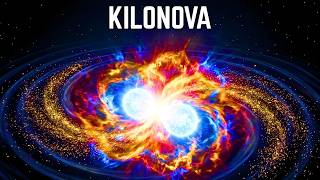
What a Kilonova Really Is… And Why It’s the Only Event Violent Enough to Create Gold
Sleep On Astrophysics · 2:25:23
What If the Sun Moved Closer and Couldn't Stop?
CrazieAstro · 11:38

Sleep One Night on This Planet and Wake Up 56 Years Later
CrazieAstro · 10:28
Astronomers May Have Just Witnessed an Explosion That Was Only Theoretical Until Now
The Void Report · 5:07
The New Race to the Moon (and Why China Might Win)
CrazieAstro · 15:40
The Most Violent Things NASA Has Ever Seen in Space
TRACE Science · 16:01
Where Did All of Earth’s Gold Actually Come From?
Rei Explores · 7:12
What a Real Black Hole Looks Like (And Why Interstellar Changed It)
CrazieAstro · 9:24
Gold Requires a Neutron Star Collision. Calcium Requires a Supernova. Your Body Required Both.
Cosmic Runebound · 7:24
James Webb Reveals an Alien World Hidden Beyond Our Solar System
CrazieAstro · 14:31
Gold Wasn't Made on Earth — Here’s Why
Simple Concepts Explained · 5:08

What if the Moon crashed into the Earth?
CrazieAstro · 11:37