
What If the Sun Moved Closer and Couldn't Stop?
If the Sun started moving towards us at 10 km every second, Earth would have about 172 days left. We follow the approach day by day: the inverse-square law that makes sunlight grow so fast, the runaway greenhouse tipping point, crossing the orbits of Venus and Mercury, the day the Sun steals the Moon, the metals melting one by one, and the invisible line (the Roche limit) where the Sun starts pulling Earth apart. The twist: the oceans never finish boiling. Turning every ocean into steam would take roughly 800 years of all the sunlight Earth receives, and the whole trip delivers less than a fifth of that. Then the part that isn't a what-if: astronomers watched a planet fall into its star (ZTF SLRN-2020), and in 2025 the James Webb Space Telescope showed the star never swelled up. The planet's orbit shrank until it fell in. Every number is worked out from the real physics: the inverse-square law, the Sun's gravity zone around Earth, and the Roche limit. The scenario is idealised (the Sun can't actually do this), and the real Earth is drifting away from the Sun by about 1.5 cm a year. Which did you expect to go first: the oceans, the Moon, or the ground under your feet? Tell me in the comments. Subscribe to Crazie Astro for more of the universe explained like this. Sources referenced: NASA Parker Solar Probe (Dec 2024 closest approach); De et al. 2023, Nature (ZTF SLRN-2020); Lau et al. 2025, ApJ (JWST follow-up); Schröder & Smith 2008 (distant future of the Sun and Earth); Genova et al. 2018 (solar mass loss from MESSENGER); NASA planetary fact sheets. #space #sun #whatif
Suggested videos
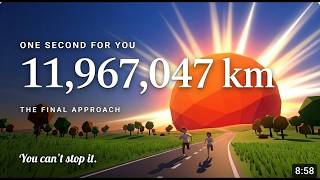
WHAT IF the Sun Moved Closer and Couldn't Stop?!
What If Lab and 2 more · 6:01
What If the Sun Moved Closer and Couldn't Stop?
What If Lab · 5:57

Sleep One Night on This Planet and Wake Up 56 Years Later
CrazieAstro · 10:28
What a Kilonova Really Is… And Why It's the Only Event Violent Enough to Create Gold
CrazieAstro · 13:34

What If the Sun Kept Getting Closer and Couldn't Stop? ☀️
Survival Science · 10:02
What a Real Black Hole Looks Like (And Why Interstellar Changed It)
CrazieAstro · 9:24
What If the Sun Moved Closer and Couldn't Stop?
As Far As We Know · 8:09
The New Race to the Moon (and Why China Might Win)
CrazieAstro · 15:40
What If The Sun Kept moving Closer and Couldn't Stop
Minute Zero · 6:06

What if the Moon crashed into the Earth?
CrazieAstro · 11:37
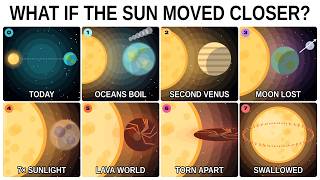
What If the Sun Moved Closer and Couldn't Stop?
Mind the Universe · 9:50
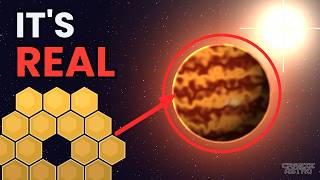
James Webb Reveals an Alien World Hidden Beyond Our Solar System
CrazieAstro · 14:31