
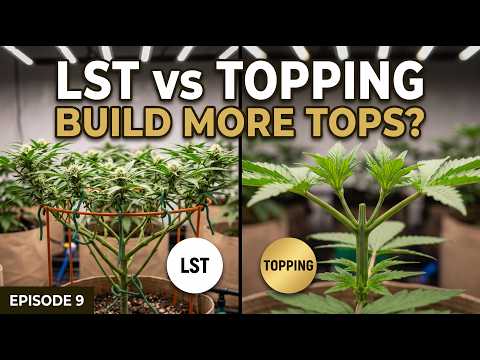
Video unavailable
This video can't be played right now.
LST vs TOPPING: The Best Way to Build an Even Canopy?
The tallest cannabis plant is not automatically the plant using its light best. If one top sits directly under the fixture while lower branches remain shaded, the answer is usually better canopy management—not more stress. In Episode 9 of The Organic Grow Roadmap, we compare low-stress training, topping, and Scrog so you can choose the right method for your plant, experience level, and grow space. You will learn how to bend and secure branches without restricting growth, why topping has a recovery cost, how to combine topping with LST, how a trellis net actually works, and when training should stop. We also cover autoflower caution, late-flower timing, stress stacking, airflow, light distribution, and the three questions to ask before you bend or cut. This episode contains no background music. The audio is clean Charon narration for maximum teaching clarity. The practical takeaway: start with gentle LST, add higher-stress techniques only when you understand the recovery cost, build the canopy before flower, and protect the structure through the finish. This episode is educational information for adults who are legally permitted to cultivate in their jurisdiction. Follow all applicable laws and local safety requirements. Cultivar, environment, and timing can change results; no training method guarantees a particular yield. Chapters 00:00 The tallest top is not always best 00:50 Beginner method: start with LST 01:13 Bend gently and leave room to grow 01:37 Why autos need extra caution 01:59 Intermediate method: topping 02:26 Topping has a recovery cost 02:54 One cut, then return to LST 03:21 CTA and the Scrog transition 03:58 Advanced method: Scrog 04:35 The stop signal for training 05:11 Three questions before you train 05:47 Measure, repeat, and know when to stop Research and further reading [1] GrowWeedEasy, “Low-Stress Training (LST) for Cannabis.” Practical LST mechanics, bending, tie-downs, canopy shape, and the distinction between bending and cutting techniques. https://www.growweedeasy.com/low-stress-training-lst [2] BudTrainer, “Cannabis Training: Every Plant Method and How to Use Them.” Practical comparison of LST, topping, super-cropping, defoliation, Scrog, training windows, and recovery cautions. https://www.budtrainer.com/blogs/learn/training [3] Garrido et al., “Subcanopy and Inter-Canopy Supplemental Light Enhances and Standardizes Yields in Medicinal Cannabis,” Plants, 2025. Controlled evidence that improving light distribution within the canopy can improve inflorescence yield and product uniformity under the tested conditions. https://pmc.ncbi.nlm.nih.gov/articles/PMC12115249/ [4] Ijoma et al., “The curious origins of a high-stress training technique mainlining,” Journal of Cannabis Research, 2025. Review of apical dominance, branching signals, mainlining, canopy uniformity, and research limitations. https://pmc.ncbi.nlm.nih.gov/articles/PMC12771868/ [5] Fluence, “10 Things Successful Cannabis Growers Are Re-Evaluating for 2026.” Current cultivation context on PPFD measurement, light uniformity, airflow, HVAC, and system-level environmental control. https://fluence-led.com/resources/ten-things-smart-cannabis-growers-are-rethinking/
Suggested videos
COMMON PESTS: Identify, Control & Prevent Spider Mites, Thrips, Gnats & Aphids
The Organic Gardener's Lab · 12:19
Topping cannabis : LST for Even Canopy : Seed to week 5
Deez Nugz AutoFlowers · 10:18
Why Are Your Leaves Turning Yellow? 7 Nutrient Deficiencies Explained
The Organic Gardener's Lab · 15:11
How to Mainline Cannabis Plants | A Step-by-Step Guide to Bigger Yields (Manifolding)
Canadian Grower · 8:04
The Vegetative Stage Decides Your Harvest - Light, Training, and Feeding Without Guesswork
The Organic Gardener's Lab · 6:05

Super Topping Cannabis to Improve Yields | Advice From Old School Cannabis Grower | Episode 5
Old School Growing · 6:20
Colombian Gold Was Never Just One Plant
The Organic Gardener's Lab · 10:38
Leggy Plant Before Flower? Why Topping Late Is the Wrong Fix | MyRemy Live
Green Zone Grow Shops · 21:27
The Drying & Curing Mistake That can Ruins a Great Harvest
The Organic Gardener's Lab · 9:42
Bonus Vid Ep2 -Stages of Training. . How Too Train your cannabis plant the GG Training. sub @ like .
HempWithGG · 7:26
FAR-RED, UV & UNDER-CANOPY LIGHTING: What Actually Works for Cannabis?
The Organic Gardener's Lab · 9:16

Trained vs Untrained autoflower cannabis plants
Grammy Learning To Grow · 7:13